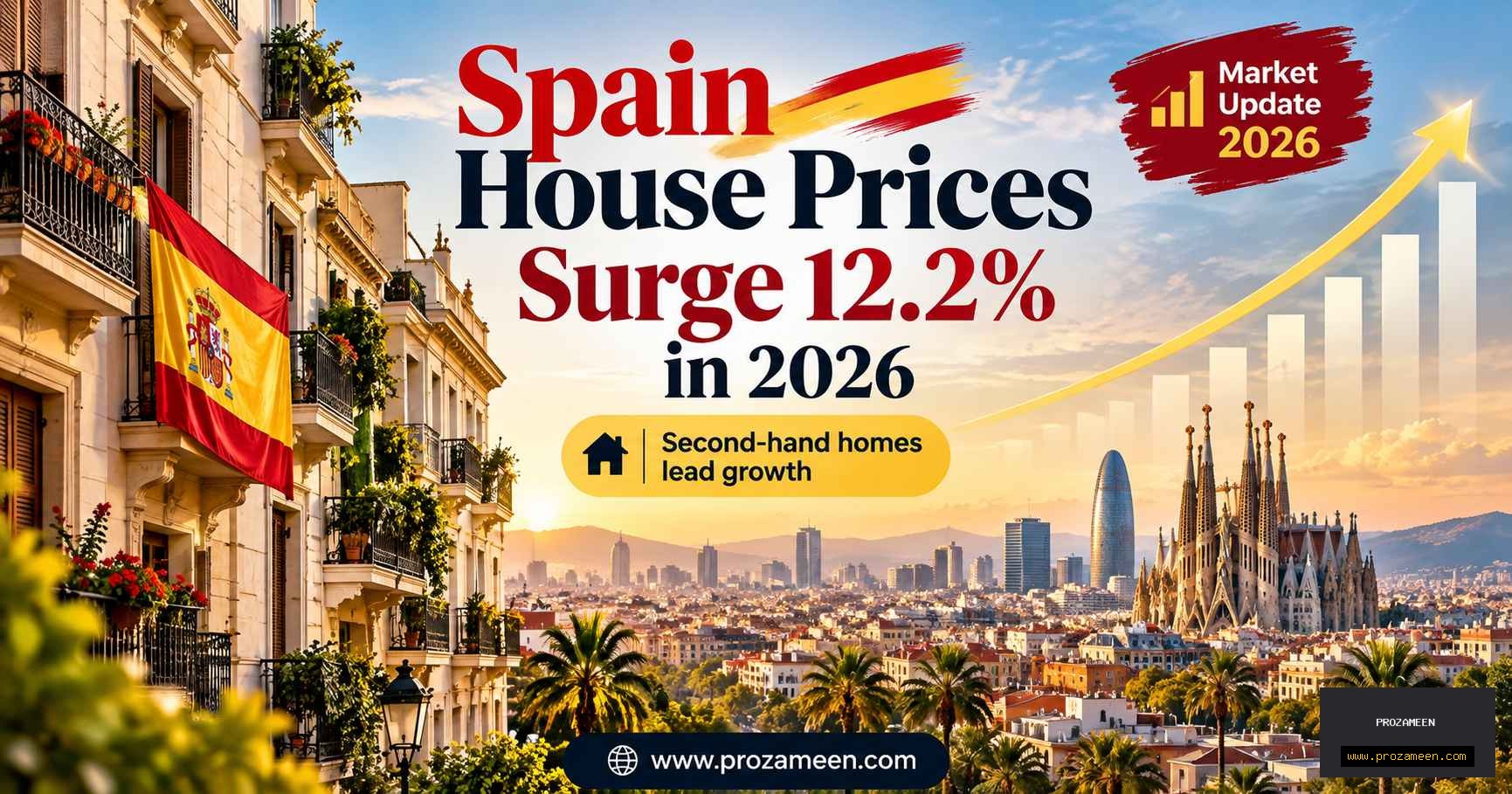
Spain House Prices Surge 12.2% in 2026
Spain’s housing market remains one of Europe’s strongest property stories in 2026.
Official data show national home prices rising 12.2% year over year in the second quarter, with second-hand properties increasing even faster at 12.9%.
That is a substantial increase for an established European housing market.
But another trend is appearing at the same time.
Home sales have started to soften.
Registered housing transactions fell in July compared with the same month a year earlier, suggesting that rapidly rising prices may finally be testing what buyers can afford.
Spain therefore enters the final months of 2026 with a fascinating combination:
Strong property-price growth, limited housing availability and signs that transaction activity is cooling.
Spain Housing Market at a Glance
The latest official indicators show:
- Overall house prices up 12.2% year over year
- Prices up 3.4% from the previous quarter
- Second-hand home prices up 12.9% annually
- New-home prices up 7.4% annually
- Around 61,417 registered home sales in July
- July housing sales down 5.1% year over year
- Approximately 78.4% of July sales were used homes
- Around 21.6% were new homes
The numbers point to a housing market where prices remain extremely strong even while transaction growth becomes less consistent.
For a broader international comparison, read Prozameen’s Global Property Price Trends Report 2026.
Why Are Spanish House Prices Rising So Fast?
There is no single explanation.
Housing prices are usually shaped by several forces acting together.
In Spain, important factors include:
- Strong housing demand
- Limited supply in desirable locations
- Slow delivery of new homes
- Population and household growth
- International buyer interest
- Employment and economic activity
- Demand for coastal and urban property
The problem is that housing supply cannot adjust quickly.
If demand increases today, developers cannot create thousands of finished homes tomorrow.
Planning, financing, construction and infrastructure take time.
That can leave existing properties competing for a large pool of buyers.
Second-Hand Homes Are Leading Price Growth
One of the most striking details in Spain’s current housing data is the difference between new and existing property.
Second-hand housing prices increased around 12.9% annually.
New-home prices rose around 7.4%.
Both are significant increases.
But the stronger rise in existing homes tells us something important about supply.
Buyers often cannot find enough suitable new properties in the places where they actually want to live.
As a result, demand spills into the second-hand market.
Why Existing Homes Matter So Much in Spain
Second-hand homes dominate transaction activity.
In July 2026, approximately 78% of registered housing sales involved used properties.
Only around 22% involved new homes.
This creates a market where the price of existing housing becomes extremely important for:
- First-time buyers
- Families
- Investors
- International buyers
- People relocating between Spanish cities
When new-home construction does not expand quickly enough, buyers compete more heavily for the available resale stock.
New Housing Supply Remains a Key Challenge
Spain’s housing problem is not simply that people want to buy homes.
It is that supply is difficult to increase in many high-demand markets.
New development can face challenges involving:
- Planning
- Land availability
- Licensing
- Construction costs
- Skilled-labour shortages
- Infrastructure
- Financing
These constraints can be particularly important in major cities and coastal markets.
When housing delivery remains below household demand for an extended period, price pressure can continue even when transaction volumes fluctuate.
Prices Are Rising Faster Than Sales
One of the most important developments for buyers to understand is that prices and sales can move in different directions.
Spain demonstrates this clearly.
Prices rose strongly in Q2.
But July registered home sales fell 5.1% compared with the previous year.
This does not necessarily mean the housing market is entering a downturn.
It could indicate that:
- Affordability is becoming more difficult
- Buyers are becoming more selective
- Fewer suitable properties are available
- High prices are reducing purchasing capacity
A market can remain expensive even when fewer transactions are completed.
July Home Sales Show Signs of Cooling
Around 61,417 home sales were registered in July 2026.
That was approximately 5.1% lower than July 2025.
Used-home sales fell more sharply than new-home transactions.
This creates an interesting question for the final months of the year:
Can Spanish house prices continue rising rapidly if transaction volumes weaken?
The answer will depend partly on how much housing becomes available and how strong demand remains.
Price Growth Is Starting to Moderate
Although prices remain high, some indicators suggest the speed of growth may be easing.
Official annual house-price growth fell from around 12.9% in the first quarter to 12.2% in the second quarter.
That is still extremely strong.
But the direction matters.
More recent market indicators also suggest that used-home price growth remained in double digits through the third quarter while moderating slightly.
That does not mean prices are falling.
It means the market may be moving from extremely rapid growth toward somewhat slower growth.
Madrid Remains a Key Market
Madrid continues to be one of Spain’s most important residential markets.
The city attracts demand from:
- Professionals
- Families
- International residents
- Businesses
- Students
- Investors
Madrid benefits from strong employment and economic activity, but affordability has become increasingly challenging.
Investors evaluating Madrid should avoid assuming that strong national price growth automatically makes every neighbourhood attractive.
Analyse:
- Property price
- Rental demand
- Transport
- Employment access
- New development
- Property condition
Prozameen’s How to Choose the Right Property Location provides a useful framework.
Barcelona Has a Different Market Dynamic
Barcelona also remains internationally important, but its housing market operates differently from Madrid.
Factors influencing Barcelona can include:
- Limited central supply
- International demand
- Tourism
- Rental regulations
- Local housing policies
- High density
Strong demand combined with limited supply can create sustained affordability pressure.
But property investors should always understand current local regulations before making assumptions about rental returns.
Valencia Is Becoming More Important
Valencia has attracted increasing attention from both domestic and international buyers.
Its appeal can include:
- Coastal lifestyle
- Urban amenities
- Lower prices than Madrid in many areas
- International connectivity
- Growing buyer interest
Rapid demand growth can create opportunities.
But it can also push property prices upward faster than local incomes.
Investors should compare current prices with realistic rental income rather than rely only on expected appreciation.
Coastal Spain Remains Highly Attractive
Spain’s Mediterranean and island markets remain a major part of its international property story.
Locations such as:
- Alicante
- Málaga
- Costa del Sol
- Balearic Islands
- Canary Islands
can attract buyers seeking:
- Second homes
- Retirement property
- Lifestyle relocation
- Rental investments
International demand can help support prices in these markets.
But coastal property should be evaluated differently from a primary-residence market.
Seasonality, short-term rental rules and international demand can all affect performance.
Foreign Buyers Remain Important
International buyers have long played a meaningful role in parts of Spain’s real estate market.
Their impact is particularly visible in:
- Coastal provinces
- Tourist destinations
- Major international cities
- Island markets
Foreign demand can broaden the pool of potential buyers.
It can also create additional competition for limited property supply.
However, investors should avoid treating foreign demand as permanently guaranteed.
Currency movements, economic conditions and regulations can change international buying behaviour.
Affordability Is Becoming the Bigger Story
Rapid house-price growth creates winners and losers.
Existing homeowners may benefit from higher property values.
But first-time buyers can face a more difficult situation.
Higher prices can require:
- Larger deposits
- Bigger mortgages
- Higher monthly payments
- Longer saving periods
Even when mortgage interest rates improve, house prices can rise quickly enough to offset part of the affordability benefit.
This is why property affordability needs to be analysed using both price and financing cost.
For broader context, see Prozameen’s Global Housing Affordability Report 2026.
Mortgage Costs Still Matter
Spain is part of the euro-area financial system, so mortgage conditions are influenced by European interest rates and Euribor.
Changes in mortgage costs can affect buyer demand quickly.
Lower borrowing costs may:
- Increase purchasing capacity
- Encourage buyers to enter the market
- Support housing demand
Higher borrowing costs can:
- Increase monthly payments
- Reduce affordability
- Slow transactions
Buyers should therefore calculate property affordability using realistic mortgage assumptions.
Prozameen’s Mortgage / EMI Calculator can help test different scenarios.
Strong Price Growth Does Not Guarantee Strong Investment Returns
Investors may see a 12.2% national price increase and conclude that Spanish real estate automatically offers strong returns.
That would be too simple.
Historical price growth does not tell you whether a property purchased today is attractive.
Investment performance also depends on:
- Purchase price
- Rent
- Vacancy
- Taxes
- Management
- Maintenance
- Financing
- Exit costs
A property can rise in value and still produce disappointing investment performance if it was purchased at too high a price.
Rental Yield Should Be Calculated Separately
Capital appreciation and rental income are different sources of return.
Consider two properties.
Property A
Lower purchase price
Moderate rent
Higher rental yield
Property B
Premium purchase price
Higher rent
Lower percentage yield
Property B may generate more rent in euros.
But Property A may produce stronger income relative to the amount invested.
Use Prozameen’s Rental Yield Calculator when comparing investment opportunities.
Do Not Chase the Fastest-Rising City
Rapid price growth can attract investors after much of the increase has already happened.
That creates a common investment mistake:
Buying because prices recently rose quickly.
Instead, investigate why prices are rising.
Ask:
- Is employment growing?
- Is housing supply genuinely limited?
- Is demand sustainable?
- Are prices supported by incomes?
- Is rent keeping pace with property values?
Momentum can be useful information.
It should not replace fundamentals.
Spain’s Housing Market Is Highly Regional
There is no single Spanish property market.
Conditions vary dramatically between:
- Madrid
- Barcelona
- Valencia
- Málaga
- Alicante
- Seville
- Northern Spain
- Interior regions
- Coastal markets
- Islands
National price statistics provide context.
The actual investment decision is local.
Before buying, use Prozameen’s How to Evaluate a Property Market Before Investing.
What Does the Market Mean for Buyers?
For buyers, Spain’s strong price growth creates a challenging environment.
Waiting for prices to fall significantly may not produce the expected result.
But rushing because prices are rising can also be dangerous.
A better approach is to focus on:
- Personal affordability
- Property condition
- Location
- Comparable prices
- Financing
- Expected ownership period
Buyers should avoid allowing fear of missing out to determine a major financial decision.
What Does It Mean for Sellers?
For sellers in strong-demand markets, conditions may remain favorable.
Properties that are:
- Well located
- Correctly priced
- Properly maintained
- Supported by strong local demand
may attract significant buyer interest.
But rapid national price growth does not justify unrealistic asking prices.
As transaction activity begins to soften, buyers may become more price-sensitive.
What Does It Mean for Investors?
Investors need to separate property-market momentum from property-level returns.
A strong Spanish market can create attractive opportunities.
But investors should still evaluate:
- Net rental income
- Local vacancy
- Financing
- Taxes
- Ownership costs
- Regulations
- Resale demand
For international investors, currency and tax considerations may also be important.
Prozameen’s Best Countries to Invest in Real Estate 2026 can help place Spain within a broader global comparison.
Supply May Determine What Happens Next
One of the biggest questions for Spain is whether housing supply can increase quickly enough.
If construction remains limited while demand stays strong, price pressure could persist.
If substantially more housing becomes available, the market could gradually become more balanced.
Watch:
- Building permits
- New completions
- Land availability
- Construction costs
- Labour availability
Housing supply often changes much more slowly than demand.
That makes it one of the most important long-term indicators.
Could Spain Become Too Expensive?
Rapid price appreciation eventually creates affordability constraints.
If households cannot keep pace with property prices, several outcomes are possible:
- Buyers purchase smaller homes
- Demand moves to suburbs
- Households rent longer
- Transactions slow
- Price growth moderates
Spain may already be showing early signs of this tension.
Strong prices combined with softer transaction volumes are worth watching carefully.
Spain Compared With Other European Markets
Spain’s housing performance stands out within Europe.
Some European property markets have experienced much slower price growth.
Others have gone through periods of stagnation or decline.
This divergence reinforces why investors should not treat European real estate as one market.
Spain currently represents one of the stronger price-growth stories.
For broader context, explore Prozameen’s Global & Regional Real Estate Market Trends 2026.
What to Watch Next in Spain
During the remainder of 2026, the most important indicators will be:
House prices
Does annual growth remain above 10%?
Home sales
Does the July slowdown continue?
Second-hand housing
Does resale property continue outperforming new homes?
Mortgage costs
Do financing conditions support demand?
New supply
Does construction begin catching up?
Affordability
Can household incomes keep pace with property prices?
Together, these indicators will show whether Spain’s housing boom continues at the same pace or starts moving toward a more balanced market.
Key Takeaways
Spain remains one of Europe’s strongest housing markets in 2026.
Official data show:
House prices up 12.2% annually.
Second-hand homes up 12.9%.
New homes up 7.4%.
Prices up 3.4% in one quarter.
But transaction data also show a changing market.
July housing sales fell 5.1% year over year.
That creates an important message for buyers and investors:
Spain’s housing market remains strong, but affordability and transaction activity deserve increasing attention.
For buyers, rising prices make careful budgeting essential.
For investors, strong historical appreciation should not replace rental and property-level analysis.
For sellers, the market remains supportive in many locations, but pricing discipline will become more important if sales continue to slow.
Spain is still a major European real estate story.
The next question is whether housing supply can expand quickly enough to prevent another year of exceptional price growth.
Important Information
Prozameen provides independent real estate information, research, calculators, tools and educational resources.
This article is based on publicly reported Spanish housing-market information available through October 2026 and is provided for general informational and educational purposes only.