
Research & Market Reports
Explore comprehensive research, market reports, and investment insights from around the world.
- Home
- /
- Research
Research Types
6 Types AvailableLatest Research (6 articles)
6 research articles found
Global Property Price Trends Report 2026
Property prices in 2026 are telling very different stories depending on where you look. Some European markets are still recording strong price growth. U.S. home prices are rising more slowly. China continues to face property-price pressure, while several emerging and developed markets are moving in completely different directions. The Prozameen Global Property Price Trends Report 2026 examines these differences and explains why there is no single global property-price trend. Executive Summary The major property-price themes in 2026 include: Real global residential prices declined during the first quarter of 2026 Nominal global prices still increased when inflation was not removed European housing markets remain comparatively strong U.S. house-price growth has slowed significantly China continues to experience falling residential prices in many cities Latin American markets have shown stronger real price growth Australia remains comparatively resilient Affordability continues to limit how quickly prices can rise Local housing supply remains a major driver of price differences Buyers should avoid using global averages to judge an individual market The most important message is simple: The global property market is becoming increasingly fragmented. Property Valuation Guide for Buyers & Investors Global Real House Prices Declined The Bank for International Settlements reported that real global residential property prices fell 1.2% year over year in the first quarter of 2026. Real prices remove the effect of consumer-price inflation, making them useful for understanding whether housing values are increasing faster or slower than general prices. The same BIS data showed that nominal global house prices actually increased by approximately 1.7% year over year during Q1 2026. This distinction matters. A property price can rise in money terms while still declining after inflation is considered. Advanced Economies Were Almost Flat in Real Terms Across advanced economies, real residential property prices declined approximately 0.2% year over year in Q1 2026. However, that average hides major differences. The BIS reported: Australia: approximately +6% Euro area: approximately +2.6% United States: approximately -2% United Kingdom: approximately -2% Canada: approximately -7% These are inflation-adjusted changes rather than nominal headline house-price movements. Europe Remains One of the Stronger Regions European property prices have generally remained resilient in 2026. Eurostat reported that house prices increased 5.1% across the European Union and 4.7% across the euro area between Q1 2025 and Q1 2026. Compared with the previous quarter, prices increased 1.2% in the EU and 1.0% in the euro area. This means European housing prices were still rising at a meaningful pace even while the broader inflation-adjusted global index was falling. Property Price Growth Varies Dramatically Within Europe Even within Europe, there is no single market trend. Eurostat reported some of the strongest annual Q1 2026 increases in: Portugal: +17.8% Bulgaria: +14.8% Slovakia: +14.4% Finland was the only EU member with available data to record an annual decline, at approximately -2.0%. The BIS inflation-adjusted data similarly identified Portugal as one of the strongest residential markets globally during Q1 2026. These differences show why European buyers should analyse individual countries and cities rather than treating Europe as one property market. Readers testing long-term price assumptions can use Prozameen's Property Appreciation Calculator, while remembering that future appreciation is never guaranteed. U.S. House Prices Are Still Rising, but Slowly U.S. home prices have not collapsed, but price growth has moderated substantially. The Federal Housing Finance Agency reported that U.S. house prices increased 2.1% between Q2 2025 and Q2 2026. Prices increased only 0.3% between Q1 and Q2 2026, indicating relatively slow quarterly growth. This nominal increase contrasts with the BIS inflation-adjusted measure, which showed U.S. real residential prices down around 2% year over year in Q1. Both figures can be correct because they measure prices differently. Why U.S. Price Growth Has Slowed Several factors are limiting U.S. property-price growth. These include: High mortgage rates Reduced buyer purchasing power Increasing housing inventory More seller price reductions Affordability constraints Greater buyer negotiating power Higher financing costs can weaken demand even when households still want to purchase homes. This is one reason transaction activity can slow without producing a dramatic national price decline. The UK Is Experiencing Modest Growth The UK housing market also shows significant regional variation. The Office for National Statistics reported that average house prices in England increased 1.1% year over year to £293,000 in July 2026. During the same period: Wales increased 2.6% Scotland increased 2.3% Northern Ireland recorded a much stronger 9.2% annual increase in Q2 2026 These figures demonstrate substantial differences within a single national housing market. China Remains a Major Source of Global Price Weakness China continues to play an important role in the global property-price decline. BIS data showed real residential prices in China down approximately 7% year over year in Q1 2026. China's National Bureau of Statistics reported continued year-over-year declines across many of the 70 large and medium-sized cities it tracks in August 2026, although the pace of decline was narrowing in several city categories. This distinction is important. The market may be experiencing slower price declines without yet returning to broad-based price growth. Shanghai Shows That China Is Not One Market China's national property weakness also hides differences between cities. Official August 2026 data showed new-home prices in Shanghai approximately 3.0% higher than one year earlier, while Beijing's corresponding index was around 2.3% lower. Many other cities continued to report year-over-year declines. This is another example of why city-level analysis is essential. Emerging Markets Are Also Highly Divided BIS data showed real residential property prices across emerging market economies declining approximately 2.0% year over year in Q1 2026. But the regional picture was dramatically different: Emerging Asia: approximately -4.3% Latin America: approximately +5.0% Other emerging economies: approximately +3.2% China's large size had a significant effect on the overall emerging-market figure. Latin America Has Been Comparatively Strong BIS data showed continued real residential property-price growth across Latin America during Q1 2026. Examples included approximately: Brazil: +5% Mexico: +4% These figures contrast sharply with declining real prices across parts of Asia. This illustrates how broad labels such as “emerging markets” can hide major regional differences. Inflation Changes the Property-Price Story One of the easiest property-market mistakes is comparing nominal price growth across countries without considering inflation. Suppose property prices rise 4% while consumer prices rise 5%. The homeowner sees a higher nominal property price, but the property's inflation-adjusted value has actually declined. This is why Prozameen distinguishes between: Nominal property prices — the actual price expressed in money. and Real property prices — the price after adjusting for inflation. Both measures are useful, but they answer different questions. Global Prices Remain Higher Than Before the Financial Crisis Short-term weakness should also be considered in a longer historical context. The BIS estimates that real global residential property prices remain approximately 20% above their levels at the end of the 2007–09 Global Financial Crisis. Since the beginning of the COVID-19 pandemic, however, real global prices have increased by only around 3%. This demonstrates how much recent inflation has changed the interpretation of nominal property-price increases. Housing Supply Remains a Major Price Driver Property prices are affected by more than interest rates. Supply matters enormously. Markets where housing construction does not keep pace with household formation, migration or urban growth may continue to experience price pressure even when financing becomes expensive. Important supply constraints include: Limited available land Planning restrictions Construction costs Labour shortages Financing costs Infrastructure capacity Slow development approvals This helps explain why some high-rate markets continue to experience rising home prices. Mortgage Rates Affect What Buyers Can Pay Property prices and mortgage rates are closely connected through affordability. When mortgage rates increase, buyers may need to: Reduce their target property price Increase their down payment Accept a smaller home Move to another area Delay purchasing However, prices do not always fall immediately because sellers may also choose not to list their properties. This can restrict supply and partly offset weaker demand. Mortgage Rates & Housing Demand Report 2026 Property Prices and Income Should Be Viewed Together A home price that appears reasonable in one country may be extremely expensive relative to local household income in another. The OECD uses the price-to-income ratio as one measure of housing affordability. It compares property prices with household disposable income and can help show whether home prices are becoming more or less affordable relative to earnings. For home buyers, local income conditions are often more useful than global property-price rankings. Property Prices and Rent Also Tell a Story The OECD also tracks the price-to-rent ratio. This compares property prices with rental prices and can help show how expensive ownership has become relative to renting. A high property price does not necessarily mean a poor investment. Likewise, a low property price does not automatically mean good value. Investors still need to analyse: Rental income Operating expenses Vacancy Financing Property condition Location Future supply Real Estate Quality Is Becoming More Important Broader 2026 market research suggests that demand is increasingly concentrated in better-quality real estate. JLL describes global demand as resilient while also highlighting greater focus on efficiency, building quality, energy availability and operational performance. This can create different price behaviour even within the same neighbourhood. Modern, efficient properties may perform differently from older buildings requiring major upgrades. What Should Home Buyers Watch? Home buyers should avoid deciding whether a market is expensive based solely on whether prices increased last year. Instead, examine: Local comparable sales Price per square metre Mortgage rates Household affordability Property condition Local housing inventory Days on market Price reductions Neighbourhood development The relevant market is usually the specific neighbourhood and property type, not the country average. Buyers evaluating an individual property can also use the Property Valuation Guide for Buyers & Investors to understand comparable sales, income approaches and other valuation considerations. What Should Property Investors Watch? Investors should combine price trends with income analysis. Important indicators include: Purchase price Rental income Rental yield Net Operating Income Cap rate Vacancy Financing costs Cash flow Future housing supply Local economic conditions Strong past price growth does not guarantee future investment performance. What Should Sellers Watch? Sellers should pay attention to current comparable transactions rather than older peak-market prices. Useful indicators include: Recent completed sales Active competing listings Price reductions Buyer demand Mortgage affordability Time on market A national market can still be rising while a particular neighbourhood or property category is weakening. Prozameen 2026 Property Price View The evidence available through September 2026 suggests that the global residential market is experiencing divergence rather than a universal boom or crash. Europe remains comparatively strong. The U.S. is experiencing slower nominal growth and slight real-price weakness. China continues to weigh heavily on global averages. Parts of Latin America and Australia remain comparatively resilient. The key property-price themes to watch through the remainder of 2026 are: Mortgage rates Housing inventory Household income New construction Inflation Buyer affordability Local migration Economic growth Rental demand Property quality The most useful conclusion for buyers and investors is therefore not that “global property prices are rising” or “global property prices are falling”. Both statements can be true depending on the market being analysed. Research Methodology This report is a Prozameen synthesis of publicly available residential property-price research and official statistics. Primary sources include: Bank for International Settlements Eurostat U.S. Federal Housing Finance Agency UK Office for National Statistics National Bureau of Statistics of China OECD JLL Different sources use different methodologies. Some statistics are nominal, while others are adjusted for inflation. Reporting periods also differ by country. For this reason, figures should be interpreted using the exact geography, methodology and period stated in the report. Research Period January 2026 to September 2026 Latest major country data incorporated: September 2026 Important Information Property-price trends vary significantly between countries, cities, neighbourhoods and property types. Prozameen provides this research report for general informational and educational purposes only.
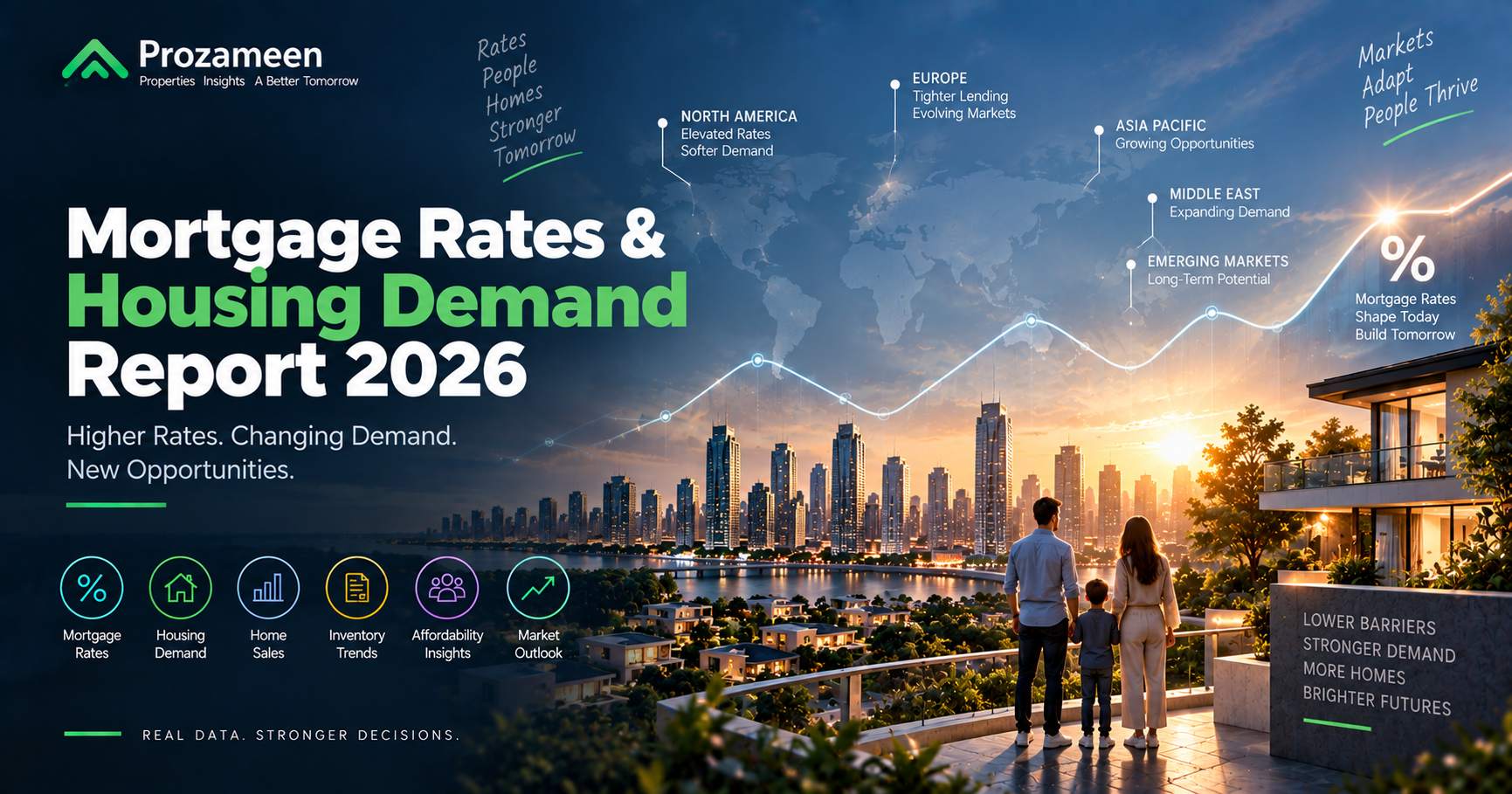
Mortgage Rates & Housing Demand Report 2026
Mortgage rates have become one of the most important forces shaping housing markets in 2026. When borrowing becomes more expensive, the impact goes far beyond the monthly mortgage payment. Higher rates can change how much buyers can afford, reduce transaction activity, alter seller behaviour and shift some households from home buying toward renting. The Prozameen Mortgage Rates & Housing Demand Report 2026 examines how financing costs are affecting housing demand, affordability, home sales and buyer behaviour across major markets. Executive Summary Several important trends are visible in 2026: Mortgage rates remain elevated in major housing markets Higher borrowing costs are reducing buyer purchasing power U.S. home sales weakened again during late summer Housing inventory has increased as demand has slowed Euro-area housing-loan demand declined during Q2 2026 European banks have tightened housing-loan standards Buyers remain highly sensitive to relatively small rate changes New-home builders are increasingly using financing incentives High mortgage costs are supporting rental demand in some markets Local affordability remains more important than any single global rate The central 2026 theme is clear: housing demand still exists, but expensive financing is preventing part of that demand from turning into completed purchases. There Is No Single Global Mortgage Rate Mortgage systems differ considerably between countries. Borrowers may use: Long-term fixed-rate mortgages Shorter fixed-rate periods Variable-rate mortgages Adjustable-rate products Government-supported financing Bank-specific lending structures For this reason, there is no meaningful single “global mortgage rate”. This report uses recent evidence from major markets, particularly the United States and euro area, to understand how borrowing costs are affecting housing demand. U.S. Mortgage Rates Are Close to 7% Freddie Mac reported that the average U.S. 30-year fixed mortgage rate reached 6.95% on September 17, 2026. The 15-year fixed rate averaged 6.26%. One year earlier, the respective averages were 6.26% and 5.41%, showing how financing conditions have become more expensive for many U.S. borrowers. For buyers financing a large portion of a home purchase, even relatively small changes in mortgage rates can materially affect monthly payments. Why Mortgage Rates Matter So Much Consider two buyers purchasing the same property with the same loan amount. If one receives a significantly lower interest rate, that buyer may have: Lower monthly payments Lower total interest costs Greater purchasing power More room for other household expenses When rates rise, buyers often respond by: Searching for cheaper properties Increasing their down payment Delaying a purchase Moving to lower-cost areas Choosing smaller homes Remaining renters for longer Housing demand therefore does not necessarily disappear. It can become financially constrained. To see how different interest rates may affect monthly payments, readers can use Prozameen's Mortgage / EMI Calculator. U.S. Buyer Demand Has Softened Higher financing costs are increasingly visible in U.S. transaction data. The National Association of Realtors reported that existing-home sales fell 2.0% month over month in August 2026 to a seasonally adjusted annual rate of 3.98 million. Sales were also 1.2% below the level recorded one year earlier. NAR linked the weaker activity partly to elevated mortgage rates. This does not mean households no longer want to buy homes. It suggests that fewer buyers can make current prices and borrowing costs work simultaneously. Rent vs Buy Market Report 2026 Pending Sales Also Show Weaker Momentum Forward-looking indicators tell a similar story. Zillow reported that newly pending U.S. home listings fell 2.6% year over year in August 2026, while home sales declined 0.6% from the previous year. Mortgage rates above 6.5% were identified as an important reason many potential buyers remained on the sidelines. NAR's September research update also reported that August pending-home sales were down 4.7% year over year. These figures reinforce the link between financing affordability and buyer activity. Buyers Have More Choice as Demand Slows One consequence of softer demand has been an improvement in housing inventory. NAR reported approximately 1.62 million existing homes available for sale in August 2026, representing 4.9 months of supply. Inventory increased 3.2% from the previous month. Zillow also reported rising inventory and greater negotiating room for buyers who are financially prepared to purchase. This creates an unusual market: Financing is expensive, but buyers who can afford it may face less competition and more property choice. Home Prices Have Not Collapsed Higher mortgage rates have reduced demand, but that has not automatically produced large national price declines. NAR reported that the median U.S. existing-home price in August 2026 was $429,100, approximately 1.6% higher than one year earlier. This shows why affordability remains difficult. Buyers are dealing with a combination of: Elevated property prices Higher financing costs Insurance Taxes Maintenance Other household expenses A slower housing market does not necessarily mean inexpensive housing. Home buyers comparing loan structures can also read the Property Financing Guide for Home Buyers for a broader explanation of mortgage and purchase-financing considerations. New-Home Demand Is Also Sensitive to Financing The U.S. Census Bureau and Department of Housing and Urban Development estimated that new single-family home sales ran at an annualised rate of 607,000 in July 2026. That was 10.5% below the June rate, while the available supply increased to approximately 9.6 months at the current sales pace. The monthly estimate carries statistical uncertainty, but it provides another indication of softer demand in the new-home market. Builders Are Using Mortgage Incentives Developers have another way to respond to higher borrowing costs: financing incentives. Rather than reducing the advertised property price significantly, builders may offer buyers: Temporary mortgage-rate reductions Permanent rate buydowns Closing-cost assistance Other financing incentives Realtor.com reported in September 2026 that nearly one in seven U.S. new-construction listings advertised a reduced mortgage rate in August, with an average advertised rate of approximately 3.92% among those offers. These incentives demonstrate how important monthly affordability has become to converting buyer interest into sales. Euro-Area Mortgage Costs Are Lower Than U.S. Rates Mortgage structures differ significantly, so direct rate comparisons should be made carefully. The European Central Bank reported that the composite cost of borrowing for new euro-area household home-purchase loans was approximately 3.54% in July 2026. Rates differed depending on the interest-rate fixation period. These figures are not directly comparable with the U.S. 30-year fixed mortgage rate because mortgage products and fixation structures differ. They nevertheless provide a useful picture of current European financing conditions. Euro-Area Housing Loan Demand Has Fallen Despite lower headline borrowing costs than in the U.S., housing-loan demand in the euro area also weakened. The ECB's July 2026 Bank Lending Survey found a net 15% decline in demand for housing loans during Q2 2026. Banks identified several major factors: Deteriorating consumer confidence Interest-rate developments Weaker housing-market expectations Banks expected housing-loan demand to decline further during Q3 2026. This illustrates that mortgage rates are only one part of housing demand. Economic confidence also matters. European Lending Standards Have Tightened Mortgage availability depends not only on the interest rate but also on whether a borrower can qualify. The ECB reported that euro-area banks tightened credit standards for housing loans in Q2 2026, with a net 9% of surveyed banks reporting tighter standards. The share of rejected housing-loan applications also increased, with a net 6% of banks reporting higher rejection rates. A household may therefore face two affordability barriers: The loan may cost more, and obtaining the loan may become more difficult. Consumers Still Expect Property Prices to Rise Higher financing costs do not necessarily mean households expect home prices to fall. The ECB's July 2026 Consumer Expectations Survey found that euro-area consumers expected the price of their own homes to increase by an average of 3.4% over the following 12 months. Consumers expected mortgage interest rates 12 months ahead to average approximately 4.9%. These are household expectations rather than forecasts, but they show that buyers may simultaneously expect expensive financing and continued property-price growth. Affordability Is More Than the Interest Rate A mortgage rate can fall while housing remains unaffordable. Similarly, rates can rise while affordability improves if property prices or household incomes move favourably. Buyers need to consider: Property price Down payment Mortgage rate Loan term Taxes Insurance Service charges Household income Maintenance Other debt The right question is therefore not simply: “Are mortgage rates high?” It is: “What monthly housing cost does this combination of price, financing and ownership expenses create?” Global Housing Affordability Report 2026 Housing Supply Also Shapes Demand Mortgage rates influence demand, but housing supply remains important. The OECD's July 2026 housing research identifies higher borrowing costs for construction, rising construction expenses, labour shortages and land-use constraints as factors limiting housing supply in OECD and EU markets. This creates a difficult relationship. High interest rates can reduce buyer demand while simultaneously making it more expensive to build new homes. If construction falls too far, future housing supply may become tighter. High Rates Can Shift Demand Toward Renting Households priced out of ownership still need somewhere to live. This can move some housing demand into the rental market. Zillow's September 2026 forecast illustrates this shift in the U.S. The company reduced its outlook for existing-home sales while increasing its rent-growth expectations, describing high mortgage rates as an important factor restraining the for-sale market. This means the ownership and rental markets should not be analysed independently. Mortgage Rate Changes Affect Buyers Unequally The effect of higher rates depends heavily on the buyer. A cash buyer may barely be affected. A highly leveraged buyer can be affected significantly. First-time buyers may face particular difficulty because they often have: Smaller down payments Less existing housing equity Greater dependence on mortgage financing Higher sensitivity to monthly payments Existing homeowners may be reluctant to sell if replacing an older low-rate mortgage with a new higher-rate loan would substantially increase their monthly cost. Higher Rates Can Also Affect Sellers Mortgage rates influence sellers indirectly. When buyer demand weakens, sellers may experience: Longer selling times More negotiations Price reductions Fewer competing offers Greater pressure to provide incentives However, sellers may also decide not to list their properties. This can reduce housing supply and partially offset the decline in demand. What Should Home Buyers Watch? Buyers should monitor more than weekly rate headlines. Important indicators include: Mortgage rate Monthly payment Property price Available inventory Price reductions Seller incentives Lending standards Household income Expected ownership period A higher-rate environment may sometimes offer better negotiating conditions even though financing is more expensive. What Should Property Sellers Watch? Sellers should pay attention to: Local buyer demand Pending sales Inventory Time on market Mortgage-rate movements Price reductions Competing listings Pricing a property based on conditions from a lower-rate market may create unrealistic expectations. What Should Investors Watch? Property investors should evaluate how financing affects both acquisition costs and tenant demand. Important factors include: Interest rates Debt-service costs Loan-to-value Rental demand Vacancy Net Operating Income DSCR Cash flow Cap rate Refinancing risk A property with attractive rental income may still produce weak investment cash flow if financing costs are too high. Prozameen 2026 Market View Evidence through September 2026 suggests that mortgage rates remain one of the strongest constraints on housing-market activity. In the U.S., 30-year mortgage rates near 7% are limiting buyer affordability and contributing to softer home sales. In the euro area, financing rates are lower under different mortgage structures, but housing-loan demand has still weakened and banks have tightened lending standards. The key themes for the remainder of 2026 are: Mortgage-rate volatility Buyer affordability Lending standards Housing inventory Seller price adjustments Builder financing incentives Rental demand Construction financing Consumer confidence A meaningful housing recovery will likely require more than lower mortgage rates alone. Affordability, supply and household confidence will also need to improve. Research Methodology This report is a Prozameen synthesis of publicly available mortgage and housing-market research. Primary sources include: Freddie Mac European Central Bank National Association of Realtors U.S. Census Bureau and HUD Zillow Research OECD Mortgage products and lending systems vary significantly between countries. U.S. 30-year mortgage rates should therefore not be directly compared with euro-area borrowing rates without considering differences in mortgage structure and rate-fixation periods. Research Period January 2026 to September 2026 Latest market data incorporated: September 17, 2026 Important Information Mortgage rates, lending requirements and housing demand vary significantly by country, lender, city and borrower. Prozameen provides this research report for general informational and educational purposes only.

Rent vs Buy Market Report 2026
Should you rent or buy a home in 2026? It sounds like a simple question, but current housing data shows why there is no universal answer. In many major markets, renting currently requires a lower monthly housing payment than buying. At the same time, buyers who remain in a property long enough may gradually build equity and recover the higher upfront and ownership costs. The Prozameen Rent vs Buy Market Report 2026 examines how property prices, rents, mortgage rates, down payments, ownership costs and expected length of stay are shaping this decision. Global Property Price Trends Report 2026 Executive Summary Several important trends define the rent-versus-buy market in 2026: Renting currently has a significant monthly cost advantage in many major U.S. markets The financial advantage of buying can improve over longer ownership periods Mortgage rates remain an important affordability barrier European house prices have generally been rising faster than rents Renting is currently more affordable than buying in many major European cities Down payments and transaction costs remain major barriers to ownership Location dramatically changes the calculation A short expected stay generally strengthens the case for renting Longer ownership periods can improve the economics of buying Monthly cost alone does not determine the better financial outcome The central lesson is that rent versus buy should be treated as a time-horizon and affordability calculation rather than a universal rule. Renting Has a Monthly Cost Advantage in the U.S. The clearest current evidence comes from the United States. Zillow reported in September 2026 that the typical U.S. renter paid approximately $1,948 per month in August, compared with approximately $3,014 per month for the typical new buyer's mortgage payment, property taxes and insurance. That represented a monthly difference of about $1,066, or nearly $12,800 per year. Zillow found renting was less expensive on a monthly basis across all 50 of the largest U.S. metropolitan areas. This does not mean renting will always produce the better long-term financial result. It means that the immediate cash-flow requirement for a new buyer is currently substantially higher in many markets. The Gap Can Be Much Larger in Expensive Cities The monthly difference between renting and buying varies dramatically by location. Zillow's August 2026 analysis estimated particularly large monthly rental advantages in expensive coastal markets, including: San Jose San Francisco Los Angeles San Diego In San Jose, Zillow estimated that renting the typical home cost approximately $7,883 less per month than the monthly cost faced by a typical new buyer under its methodology. This illustrates why national averages should never replace local research. Monthly Cost Is Only Part of the Story A lower monthly rent does not automatically mean renting produces the best long-term financial outcome. Homeowners gradually repay mortgage principal and may build equity. Renters do not build property equity, but they may retain money that would otherwise have been used for: Down payment Closing costs Higher monthly payments Property maintenance Repairs If renters save or invest those differences, the financial comparison changes significantly. A proper rent-versus-buy analysis therefore needs to compare wealth accumulated under both scenarios, not simply rent versus mortgage payments. Buying Can Become More Competitive Over Time Zillow's June 2026 rent-versus-buy model estimated that a purchaser of the typical U.S. home would financially break even compared with renting after approximately 5.9 years with a 5% down payment and around 6.0 years with 20% down, based on the assumptions used in its model. This helps explain an apparent contradiction in the market: Renting may be substantially cheaper today, while buying may become financially competitive after several years. The expected length of stay is therefore one of the most important factors in the decision. The Break-Even Period Varies by City There is no universal number of years that makes buying better. Zillow estimated that buy-versus-rent break-even could arrive within roughly 3.5 to 4.2 years in markets such as Columbus, Memphis and Buffalo, depending on down payment assumptions. At the opposite end, its model found that current prices and rents in San Francisco, San Jose and New Orleans left renting ahead even across a 30-year modelling horizon. The differences reflect local combinations of: Property prices Rents Property taxes Insurance Expected appreciation Transaction costs Mortgage costs U.S. Buyers Still Face High Financing Costs The cost of financing continues to affect the rent-versus-buy calculation. Zillow reported in its August 2026 housing-market update that mortgage rates remained above 6.5%, while the typical U.S. home value was approximately $369,678. The report described renting as the more affordable current option for many households because borrowing costs remain elevated. Higher interest rates increase the monthly payment without increasing the amount of property the buyer owns. Renting Also Has Costs That Can Change Renting is not financially static. Rents can increase, and households may face: Security deposits Moving expenses Parking costs Utility charges Rent increases at renewal Repeated relocation costs Zillow reported that typical U.S. rent reached $1,948 in August 2026, approximately 2.5% higher than one year earlier. This means today's rental advantage may change over time. Buyers can use the Mortgage / EMI Calculator to estimate monthly mortgage payments under different prices, down payments and interest rates. Rental Concessions Can Lower the Effective Rent Headline asking rent may also overstate what a renter effectively pays. In July 2026, Zillow reported that 39.8% of U.S. rental listings offered some form of concession, such as free rent, waived fees or other incentives. Renters comparing costs should therefore investigate the effective rental cost rather than relying only on the advertised monthly price. Europe Shows a Similar Affordability Challenge The rent-versus-buy question is also important across Europe. JLL reported that in the second quarter of 2026, renting was more affordable than buying in approximately two-thirds of the key European cities included in its analysis, largely because of high property prices and mortgage costs. However, renting is not becoming cheaper everywhere. The same JLL analysis showed average residential rents across its European city sample increasing around 3.4%, slightly faster than residential sales prices at 3.1% in Q2 2026. Global Housing Affordability Report 2026 EU House Prices Are Rising Faster Than Rents Eurostat provides a broader view of European housing trends. In the first quarter of 2026, EU house prices increased 5.1% year over year, while rents increased 3.0%. Compared with the previous quarter, house prices increased 1.2% and rents 0.7%. When purchase prices grow faster than rents, buying can become relatively more expensive for new entrants even if existing homeowners benefit from rising property values. Mortgage Costs Still Matter in Europe Financing remains important in European affordability. The European Central Bank reported that the composite cost of borrowing for euro-area household home purchases was approximately 3.54% in July 2026. The ECB also reported that euro-area banks tightened housing-loan credit standards during Q2 2026 and that demand for housing loans declined markedly. These conditions can make purchasing more difficult even when households have adequate income. Mortgage Rates & Housing Demand Report 2026 Down Payment Is a Major Difference Between Renting and Buying One of the biggest barriers to purchasing is not the monthly payment. It is the amount of money required before the purchase is completed. Buyers may need funds for: Down payment Mortgage fees Legal costs Registration or transfer charges Taxes Property inspection Moving Initial repairs Renters usually face much smaller upfront costs. This can make renting more accessible even when a household could theoretically manage the monthly mortgage payment. Ownership Has Costs Beyond the Mortgage A fair comparison should never compare rent with mortgage principal and interest alone. Homeowners may also need to pay: Property taxes Home insurance Service or association fees Maintenance Repairs Utilities Renovations Selling costs Zillow's rent-versus-buy methodology specifically incorporates ownership expenses including taxes, insurance, maintenance and closing costs when comparing the financial paths of renters and buyers. Renting Provides Greater Flexibility Financial calculations are important, but housing is also a lifestyle decision. Renting may suit households that: Expect to move soon May change jobs Are uncertain about location Want fewer maintenance responsibilities Need greater mobility Want to preserve cash Buying generally involves higher transaction costs and may be less suitable for a short expected stay. Buying Can Provide Greater Stability Home ownership may offer benefits that are difficult to express through a simple spreadsheet. These may include: Greater housing stability More control over improvements Less exposure to lease renewal decisions Potential equity accumulation Greater ability to personalise the home Whether those benefits justify the additional cost depends on the household. Housing Supply Influences Both Choices Renting and buying do not operate as completely separate markets. A shortage of homes can increase both property prices and rents. The OECD's July 2026 housing research describes persistent housing affordability pressure across many OECD and EU countries as partly the result of an imbalance between housing demand and supply, influenced by construction costs, labour shortages, financing costs and land-use restrictions. Greater housing supply can improve choice in both rental and ownership markets. Price-to-Rent Ratios Can Help With Market Research One useful market-level measure is the price-to-rent ratio. It compares property prices with rental costs. The OECD notes that the price-to-rent ratio can provide an indicator of the relative economics of housing ownership, although it should not be treated as a complete personal rent-versus-buy calculation. A relatively high price-to-rent ratio may indicate that purchasing is expensive compared with renting. But financing, taxes and expected ownership duration still matter. Renters can compare those ownership costs with upfront rental expenses using the Rental Move-In Cost Planner The Decision Changes With Your Time Horizon For someone expecting to live somewhere for one or two years, purchasing may involve too many transaction costs to recover comfortably. For someone planning to remain for a decade or longer, buying may have more time to absorb: Purchase costs Selling costs Market fluctuations Maintenance expenses and potentially benefit from: Mortgage principal repayment Property appreciation Longer-term housing stability This is why expected length of stay should be one of the first questions in a rent-versus-buy analysis. What Should Renters Compare? A renter should consider: Monthly rent Rent increases Deposit Utilities Parking Insurance where applicable Moving frequency Flexibility If renting creates substantial monthly savings compared with buying, consider what happens to those savings. The comparison becomes much more meaningful if the renter deliberately saves or invests part of the difference. What Should Buyers Compare? A potential buyer should estimate the complete cost of ownership. That includes: Down payment Mortgage payment Interest Taxes Insurance Service charges Maintenance Repairs Purchase costs Selling costs Opportunity cost of invested capital Buyers should also consider how long they expect to own the property. Prozameen 2026 Rent vs Buy View The evidence available through September 2026 suggests that renting currently offers a stronger short-term affordability position in many expensive housing markets. In the United States, typical rental costs are materially below the monthly cost facing new home buyers. European data also shows renting is currently more affordable than purchasing in many major cities. However, the decision changes when the time horizon becomes longer. Buyers can build equity, while renters may build wealth by investing money that would otherwise have gone toward higher housing costs and a down payment. The most important factors to evaluate are: Local rent Local property price Mortgage rate Down payment Ownership expenses Expected rent growth Expected length of stay Transaction costs Financial flexibility There is therefore no universal winner between renting and buying. The stronger choice depends on the household, the location and the time horizon. Research Methodology This report is a Prozameen synthesis of publicly available housing-market research. Primary sources include: Zillow Research Realtor.com Economic Research JLL Eurostat European Central Bank OECD The report combines evidence from several markets to explain broader rent-versus-buy dynamics. U.S. statistics should not be treated as global averages, and European statistics should not automatically be applied to other regions. Research Period January 2026 to September 2026 Latest major data incorporated: September 2026 Important Information Housing prices, rents, mortgage rates, taxes and transaction costs vary significantly between countries, cities and individual properties. Prozameen provides this research report for general informational and educational purposes only.

Global Rental Market Trends 2026
The global rental market in 2026 is being shaped by two powerful forces: strong demand for rental housing and uneven growth in new supply. In some cities, years of apartment construction have given renters more choices and negotiating power. In others, limited housing supply continues to push rents higher. The result is not one global rental trend, but a market increasingly divided by city, property type, affordability and housing supply. The Prozameen Global Rental Market Trends 2026 report examines the major forces influencing renters, landlords and property investors across key international markets. Executive Summary Several themes stand out in the rental market during 2026: Rental demand remains resilient in many major cities Rent growth varies significantly between markets New apartment supply has moderated rent growth in some locations Markets with limited supply are experiencing stronger rental pressure Rental affordability remains challenging for many households Rent concessions remain common in some high-supply U.S. markets European rental growth continues despite affordability pressure Institutional investment in rental and living assets is increasing Investors are increasingly focused on occupancy, operating costs and sustainable rental income Local supply and demand matter more than headline global averages The most important lesson from 2026 is that rental supply is becoming one of the strongest factors determining rent growth and tenant bargaining power. There Is No Single Global Rent Trend Unlike interest rates or some financial-market indicators, there is no single official global rental-price index covering every country and property type. Rental markets operate locally. A city experiencing rapid population growth and limited housing construction can behave very differently from a city where thousands of new apartments have recently entered the market. This means global rental research should focus on regional and city-level evidence rather than assuming that one country's rental trend represents the world. United States: Rent Growth Is Accelerating Again The U.S. rental market provides a clear example of how additional housing supply can influence rents. According to Zillow, the typical U.S. asking rent reached $1,962 in July 2026, representing annual growth of 2.3%, the fastest annual pace in more than a year. However, renters still have negotiating power in many markets. Zillow reported that 39.8% of U.S. rental listings offered a concession in July 2026, compared with 35.9% one year earlier. Concessions may include free rent, waived fees or other move-in incentives. This creates an unusual market where rents are rising while incentives remain widespread. Global Real Estate Market Outlook 2026 New Supply Has Helped U.S. Renters A large wave of apartment construction has helped limit rental growth in several U.S. cities. Markets that added substantial new supply have generally offered renters more choices and more concessions. For example, Zillow reported particularly high concession rates in Charlotte, Denver and Dallas during July 2026. At the same time, cities where supply is tighter have experienced stronger rent growth. This demonstrates an important rental-market principle: More housing supply can increase competition between landlords and reduce pressure on renters. The U.S. Supply Wave Is Beginning to Slow The rental construction boom that supported renters over the past few years is beginning to moderate. Zillow reported that multifamily permits in the second quarter of 2026 were 31% below their most recent peak in 2022. CBRE also reported that U.S. multifamily construction completions fell 14% year over year in Q2 2026, while renter absorption remained strong. If new supply continues to fall while demand remains strong, some rental markets could gradually become tighter. U.S. Rental Affordability Remains Challenging Moderate rent growth does not necessarily mean renting is affordable. Zillow estimates that a median-income U.S. household would spend approximately 26.8% of its income on a new rental in July 2026. The income required to afford the typical rental was approximately $78,488 per year. The affordability burden differs significantly by city. In July 2026, Zillow estimated that renters in New York would spend about 40.9% of median household income on a typical new rental, compared with considerably lower shares in markets such as Raleigh and Salt Lake City. Global Housing Affordability Report 2026 Europe: Rents Continue to Rise European rental markets also remain under pressure. Eurostat reported that EU rents increased 3.0% year over year in the first quarter of 2026. Compared with the fourth quarter of 2025, EU rents increased by 0.7%. At the same time, house prices increased faster than rents across much of the EU, with annual house-price growth of 5.1% in Q1 2026. This relationship between purchase prices and rents is important because high home-buying costs can keep more households in the rental market. European Cities Face a Supply Problem JLL's 2026 European living research highlights declining housing supply as a major concern. The company expects new living-sector supply in Europe to fall to its lowest level in more than two decades, while affordability pressure remains significant in many cities. By Q2 2026, JLL reported that average residential rents across the European cities it tracks were growing by approximately 3.4%, slightly faster than the 3.1% growth in residential sales prices across those markets. JLL also estimated that renting was more affordable than buying in roughly two-thirds of the key European cities in its analysis because of high property prices and mortgage costs. Germany Shows How Affordability Can Slow Rent Growth Germany provides an example of rental growth slowing when tenants reach affordability limits. JLL reported that median asking rents in Germany's eight largest cities reached €17.98 per square metre in the first half of 2026, increasing approximately 3.0% annually. That was less than half the 6.8% annual growth recorded during the comparable period one year earlier. JLL attributed much of the slowdown to increasing affordability pressure in major cities. Interestingly, rental growth was stronger in some smaller cities and rural districts. This shows how affordability pressures can cause rental growth to shift geographically rather than disappear entirely. Asia Pacific Remains Highly Diverse Asia Pacific cannot be described as one rental market. Large differences exist between countries and cities based on: Urbanisation Population growth New construction International migration Local regulation Employment growth Housing availability Savills' 2026 occupier outlook reported broad expectations for continued residential rental demand across many international markets, with particularly strong expectations for rental growth in selected markets including India. These were market expectations rather than completed full-year results, so they should be interpreted as outlook indicators rather than confirmed future performance. Hong Kong Illustrates Demand From International Mobility Hong Kong provides a useful example of how migration and relocation can affect rental demand. JLL reported that expatriate relocations handled by relocation specialist Dwellworks Hong Kong increased 20% year over year during the first half of 2026. JLL expects luxury residential rents in Hong Kong to increase by around 5% during 2026, supported by relocation demand. This relates specifically to Hong Kong's luxury rental segment and should not be interpreted as representing the entire Asia-Pacific rental market. Rental Housing Is Attracting More Investment Institutional investors continue to increase their exposure to rental and living-sector real estate. JLL reported that global living-sector investment increased approximately 9% in the first half of 2026 compared with H1 2025, with more than $114 billion in direct investment. The living sector includes formats such as: Multifamily rental housing Build-to-rent Student housing Senior living Other professionally managed residential formats This investment activity suggests that large investors continue to see long-term demand for rental housing. European Living Investment Is Also Growing Investment momentum has been particularly visible in Europe. JLL reported that EMEA living-sector investment reached €17.4 billion in Q2 2026, an increase of 49% year over year. Total investment for the first half of 2026 reached €31.2 billion, around 10% higher than the same period in 2025. Large multifamily transactions in countries including Sweden, the UK and Spain contributed significantly to this growth. Why Investors Like Rental Housing Rental housing can offer characteristics attractive to long-term investors, including: Recurring rental income Broad household demand Potential inflation-linked rent growth Large tenant markets Portfolio diversification Long-term urbanisation trends But rental property also comes with risks. These include: Vacancy Maintenance Regulation Tenant affordability Financing costs Property management Local oversupply Strong demand does not automatically make every rental property a strong investment. Rent vs Buy Market Report 2026 Rent Growth and Rental Profit Are Different A common mistake is assuming that rising rents automatically mean higher investment returns. Rental profitability depends on both income and expenses. Investors need to consider: Rental income Vacancy Maintenance Insurance Property management Service charges Taxes where applicable Mortgage payments Interest costs Renovation expenses A property experiencing strong rental growth can still produce weak cash flow if operating and financing costs are high. Rental Concessions Matter Advertised rent does not always represent the effective rent paid by a tenant. Landlords may offer: One month free Reduced deposits Waived application fees Free parking Other incentives This is particularly important in markets with significant new apartment supply. Nearly two in five U.S. rental listings on Zillow offered a concession in July 2026, demonstrating why investors and renters should look beyond headline asking rents. Single-Family and Apartment Rents Can Behave Differently Rental-property type also matters. Zillow reported in June 2026 that U.S. single-family rents were increasing approximately twice as quickly as multifamily apartment rents — 3.0% annually compared with 1.5%. The difference reflected, in part, the much larger amount of new apartment supply entering the market. Investors should therefore avoid treating all rental properties as one market. Affordability May Limit Future Rent Growth Landlords cannot assume rents can continue increasing indefinitely. When rent grows faster than household income, tenants may respond by: Moving to cheaper locations Sharing accommodation Choosing smaller homes Remaining with existing landlords Delaying household formation Moving farther from city centres Affordability can therefore act as a natural limit on rental growth. This is already visible in some European cities where JLL has reported slower rental growth as tenant affordability becomes increasingly constrained. Location Remains Critical Rental demand can vary significantly within the same city. Important location factors include: Employment Public transport Universities Schools Shopping Healthcare Entertainment Safety New development Competing rental supply A property in a high-demand neighbourhood may perform very differently from a similar property only a few kilometres away. What Should Renters Watch? Renters should look beyond the headline monthly rent. Important factors include: Effective rent after concessions Deposit Utilities Parking Service charges Lease length Expected rent increases Transport costs Renewal conditions In markets with abundant supply, renters may have greater negotiating power. What Should Landlords Watch? Landlords should focus on occupancy and sustainable income rather than rent increases alone. Important indicators include: Local vacancy New construction Tenant turnover Rental concessions Competing listings Maintenance costs Tenant affordability Renewal rates A smaller rent increase with stable occupancy can sometimes produce a stronger financial result than aggressively increasing rents and experiencing longer vacancies. What Should Property Investors Watch? Investors should evaluate rental property using several measures rather than rent growth alone. Useful indicators include: Rental yield Net Operating Income Cash flow Cash-on-cash return Cap rate Vacancy Tenant turnover Operating expenses Financing costs The strongest rental investments are usually those where income, costs, location and tenant demand remain sustainable together. Property investors can use the Rental Yield Calculator to compare annual rental income with property value and operating expenses. Prozameen 2026 Rental Market View The rental market in 2026 is best described as resilient but highly uneven. Demand for rental housing remains strong in many markets because home ownership remains expensive and urban populations continue to require housing. At the same time, recent construction has created more competition between landlords in some cities. The most important trends to watch through the remainder of 2026 are: Slowing new apartment construction Rental affordability Vacancy levels Tenant concessions Local wage growth Migration Mortgage affordability Institutional investment Regulation Operating expenses Markets where construction slows while tenant demand remains strong may experience greater rental pressure over time. Markets with substantial available supply may continue to offer renters more choice and negotiating power. Research Methodology This report is a Prozameen synthesis of publicly available rental and living-sector research. Primary sources include: JLL CBRE Savills Research Eurostat Zillow Research The report combines evidence from multiple regions because there is no single official global rent index covering all residential rental markets. Market statistics should therefore be interpreted according to their stated country, city, property type and reporting period. For readers unfamiliar with property income analysis, Prozameen's Net Operating Income (NOI) glossary explains how rental income changes after operating expenses are considered. Research Period January 2026 to September 2026 Latest major data incorporated: August 2026 Important Information Rental markets vary significantly by country, city, neighbourhood and property type. Prozameen provides this research report for general informational and educational purposes only.

Global Housing Affordability Report 2026
For millions of households, the biggest housing question in 2026 is no longer simply whether property prices are rising or falling. The more important question is: Can people actually afford to rent or buy a suitable home? Housing affordability depends on several factors working together, including property prices, rent, household income, mortgage rates, construction costs, housing supply and everyday living expenses. The Prozameen Global Housing Affordability Report 2026 examines the major forces shaping affordability around the world and explains why falling property prices alone do not necessarily make housing affordable. Executive Summary Housing affordability remains one of the most serious challenges facing global property markets in 2026. Important findings include: Housing shortages remain substantial in many regions Rent continues to consume a large share of household income High construction and financing costs are limiting new supply Property prices are moving differently across countries Lower-income renters face particularly strong pressure Mortgage affordability remains sensitive to interest rates Large cities often face more severe affordability constraints Housing supply is becoming increasingly important to long-term affordability Climate resilience and adequate housing quality are becoming part of the affordability discussion The global affordability problem is therefore not simply a question of whether homes are expensive. Mortgage Rates & Housing Demand Report 2026 It is increasingly a supply, income, financing and urban-development challenge. The Scale of the Global Housing Challenge UN-Habitat's World Cities Report 2026 describes the current housing situation as a global crisis shaped by affordability, displacement, informal housing, climate risks and neighbourhood liveability. Its latest estimates indicate that up to 3.4 billion people worldwide lack access to adequate housing, including more than 1.1 billion people living in informal settlements and slums. UN-Habitat also estimates that the global housing deficit increased from approximately 251 million housing units in 2010 to 288 million in 2023. These figures show that affordability cannot be separated from the broader question of whether enough suitable housing exists. Housing Costs Are Taking More Household Income One of the clearest signs of affordability pressure is the share of household income spent on housing. UN-Habitat's 2026 flagship research estimates that 44% of households globally spend more than 30% of their income on rent, although burdens vary substantially between regions and income groups. A household spending a very high share of its income on housing may have less money available for: Food Transport Healthcare Education Savings Emergencies Retirement Other essential expenses This is why affordability should be evaluated relative to household income rather than property price alone. Property Prices Are Not Moving in One Direction Global residential property prices are not experiencing one universal trend in 2026. According to the Bank for International Settlements, real global house prices declined 1.2% year over year in the first quarter of 2026. Real prices declined by 0.2% across advanced economies and by 2.0% across emerging market economies, although Europe showed different trends, including a 2.6% increase in the euro area. This demonstrates why a global headline such as "house prices are falling" can be misleading for individual buyers. Affordability remains highly local. Lower Prices Do Not Automatically Mean Affordable Homes A property can become cheaper while still remaining difficult to afford. For example, affordability may remain weak when: Mortgage rates are high Household income grows slowly Down payment requirements are large Taxes and transaction costs are high Housing supply remains limited Insurance and maintenance costs increase Buyers therefore need to consider the total cost of ownership, not only the advertised property price. Housing Supply Is a Central Problem Insufficient housing supply is increasingly recognised as a major driver of affordability problems. The OECD's July 2026 research identifies several factors limiting affordable housing supply across OECD and EU countries: Rising construction costs Construction labour shortages Higher borrowing costs for developers Restrictive land-use policies Insufficient public investment Limited affordable and social housing stock The OECD concludes that persistent supply-and-demand imbalances have contributed to rising housing costs and increasing financial pressure on households. This suggests that improving affordability requires more than short-term changes in mortgage rates. In many markets, increasing housing supply is likely to remain a long-term challenge. Construction Costs Affect Future Affordability Building new homes has become more expensive in many markets. Developers may face higher costs for: Land Materials Labour Financing Energy Infrastructure Planning and approvals When the cost of delivering new housing rises, fewer projects may be financially viable. This can restrict future housing supply and place additional pressure on both purchase prices and rents. Renters Face Different Affordability Pressures Renters and homeowners experience housing affordability differently. Renters may be affected by: Rent increases Housing shortages Security deposits Utility costs Limited supply in desirable locations Home buyers may face: Property prices Down payments Mortgage interest Transaction costs Insurance Maintenance Neither renting nor buying is automatically more affordable. The answer depends on the local market and household circumstances. Europe Shows How Uneven the Burden Can Be Europe provides a useful example of how affordability pressures can affect different groups differently. An IMF working paper published in August 2026 found that supply-side factors have become increasingly important in explaining house-price pressures in Europe. The research also found that lower-income urban renters have been disproportionately affected, facing both higher rents and reduced chances of transitioning into home ownership. This is a European finding rather than a global statistic, but it illustrates why affordability analysis should examine different household groups rather than relying only on national averages. Affordability Can Affect Where People Live and Work Housing affordability also has wider economic effects. The same IMF research estimates that housing affordability constraints may have contributed to around one million foregone residential moves within the EU during the past decade, potentially reducing labour mobility. When people cannot afford housing near employment opportunities, cities may struggle to attract workers even when jobs are available. Housing affordability is therefore connected with: Employment Productivity Transport Urban development Household wealth Economic opportunity First-Time Buyers Face Particular Challenges First-time buyers often experience affordability differently from existing homeowners. They may need to manage: Saving a down payment Mortgage qualification Current rent payments Transaction costs Higher interest rates Limited savings Competition for entry-level homes Existing homeowners may already have property equity that can help finance their next purchase. This difference can make the path to home ownership particularly difficult for younger and first-time buyers. Rent vs Buy Market Report 2026 Mortgage Rates Still Matter Housing affordability is strongly affected by the cost of borrowing. Even if the property price remains unchanged, a higher mortgage interest rate can significantly increase monthly payments. Buyers should therefore consider: Property price Down payment Mortgage amount Interest rate Loan term Monthly payment Other ownership costs Affordability calculations should also consider how the household budget would cope if financing costs changed. Rental Affordability Matters Too The housing affordability debate often focuses heavily on home ownership. But rental affordability is equally important. A household may be unable to save for a future down payment if a large portion of its income is already being spent on rent. High rents can therefore create a cycle where households struggle both to afford their current housing and to build the savings needed to purchase a home. Cities Face the Strongest Pressure Urbanisation continues to increase housing demand in many cities. UN-Habitat projects that urban areas could absorb approximately 2 billion additional residents by 2050, placing further pressure on housing systems that are already constrained. The challenge is not simply building more homes. New housing also needs access to: Jobs Public transport Schools Healthcare Infrastructure Public spaces Essential services A home that is inexpensive but poorly connected may not provide genuine affordability once transport and other costs are considered. Adequate Housing Matters as Much as Cheap Housing Affordability should not mean accepting unsafe or unsuitable housing. UN-Habitat emphasises that adequate housing also involves factors such as: Security of tenure Basic services Safety Suitable living conditions Location Climate resilience This means housing policy should focus not only on increasing the number of units but also on ensuring that homes remain suitable and liveable. Climate Risk Is Becoming a Housing Cost Climate risk is increasingly relevant to housing affordability. UN-Habitat estimates that climate-related hazards could destroy 167 million homes by 2040 if resilience does not improve. Climate-related costs may affect households through: Insurance Repairs Energy costs Adaptation Property maintenance Infrastructure costs A property's long-term affordability may therefore depend partly on its exposure to climate and environmental risks. What Should Home Buyers Watch? For buyers, the most useful affordability question is not simply: "Can I qualify for the mortgage?" A better question is: "Can I comfortably afford the total cost of owning this property?" Important factors include: Monthly mortgage payment Down payment Property taxes Insurance Service charges Utilities Maintenance Repairs Transport Emergency savings A lender's maximum loan amount and a household's comfortable property budget may be very different. What Should Renters Watch? Renters should consider: Rent as a percentage of income Expected rent increases Utility costs Transport expenses Deposit requirements Rental stability Availability of comparable homes A cheaper rental farther away may not necessarily be more affordable if transport costs and commuting time increase significantly. What Should Property Investors Watch? For investors, affordability matters because it affects tenant demand and the sustainability of rental income. Important indicators include: Local incomes Typical rents Rent-to-income ratios Vacancy New housing supply Employment Financing costs Property prices Rental growth that moves far ahead of household income may eventually encounter affordability limits. Prozameen 2026 Affordability View The evidence available through September 2026 suggests that the global housing affordability problem remains fundamentally structural. Some markets are experiencing softer property prices, but affordability challenges remain because housing supply, household income, borrowing costs and rental pressure are moving at different speeds. The most important affordability themes to watch are: Housing supply Mortgage costs Rent-to-income pressure Construction costs First-time buyer access Urban housing shortages Infrastructure Climate resilience Local income growth The global housing market is therefore unlikely to solve its affordability problem through price movements alone. Long-term improvement will depend heavily on whether markets can deliver enough suitable housing in locations where people actually need to live. Research Methodology This report is a Prozameen synthesis of current publicly available housing research. Primary sources used include: UN-Habitat World Cities Report 2026 UN-Habitat SDG 11 Global Report 2026 OECD housing affordability research published July 2026 Bank for International Settlements residential property statistics for Q1 2026 International Monetary Fund housing-affordability research published in 2026 Different organisations use different definitions of affordability and different geographic coverage. Global figures should therefore not be interpreted as describing every individual country or city. Research Period January 2026 to September 2026 Latest major data incorporated: August–September 2026 Important Information Housing affordability differs significantly across countries, cities, household types and income groups. Prozameen provides this research report for general informational and educational purposes only. Readers comparing borrowing costs can use the Mortgage / EMI Calculator to estimate how interest rates and loan terms affect monthly payments.

Global Real Estate Market Outlook 2026
The global real estate market entered 2026 with improving investment activity, resilient demand in several property sectors and better access to capital than during the previous market slowdown. But this is not a uniform global property boom. Interest rates remain higher than the ultra-low levels seen before 2022, housing affordability remains difficult in many countries, construction costs are elevated, and economic and geopolitical uncertainty continues to influence investment decisions. The overall picture in 2026 is therefore one of gradual recovery, stronger selectivity and growing differences between property types and locations. Executive Summary Several important themes are shaping global real estate in 2026: Global property investment activity is recovering Capital is returning, but investors remain selective Prime and high-quality properties continue to attract stronger demand Housing affordability remains a major challenge Rental and living sectors continue to attract institutional interest Office markets are increasingly divided by building quality and location Logistics demand remains supported by changing supply chains AI is affecting offices, data centres and real estate operations Energy availability and operating efficiency are becoming more important Local market conditions matter more than broad global averages The strongest message from the 2026 market is simple: real estate recovery is continuing, but quality, location, income and operating performance matter more than they did during the era of very cheap financing. Global Economic Environment Real estate markets are closely connected to economic growth, inflation, interest rates and access to financing. The International Monetary Fund's July 2026 outlook projects global economic growth of 3.0% in 2026 and 3.4% in 2027. The IMF also notes that global disinflation has stalled and that economic performance remains uneven across countries. For property markets, this means borrowing conditions and investor confidence may continue to differ significantly between regions. Lower or stabilising financing costs can support property transactions, but interest rates in many markets remain above the exceptionally low levels experienced before the recent inflation cycle. Global Real Estate Investment Is Recovering Global real estate investment activity has continued to improve in 2026. Savills Research estimates that approximately $500 billion was invested globally during the first half of 2026, representing close to a 20% increase from the same period of 2025. Savills currently forecasts approximately $1.2 trillion of global real estate investment in 2026, around 14% higher than the previous year. These figures primarily relate to institutional and income-producing real estate rather than every residential home transaction worldwide. This recovery suggests that investors are becoming more willing to deploy capital as pricing becomes clearer and financing markets improve. However, the recovery remains uneven and can still be interrupted by economic or geopolitical volatility. Mortgage Rates & Housing Demand Report 2026 Investors Are Becoming More Selective The return of capital does not mean investors are buying every type of property. Investors are increasingly focused on: Strong locations Reliable rental income High-quality buildings Energy efficiency Modern amenities Operational performance Long-term tenant demand CBRE's 2026 Global Investor Intentions Survey found that investors across all regions expected to increase both buying and selling activity compared with the previous year. Preferred property sectors differ by region. Residential property has attracted strong investor interest in North America and Europe, while offices and logistics remain important in other regions. Rental Yield Calculator Residential and Living Sectors Remain Important Housing and professionally managed living sectors continue to attract significant investment. JLL reports that global living-sector investment during the first half of 2026 increased by approximately 9% compared with the first half of 2025, with more than $114 billion in direct investment. Investor interest is increasingly extending beyond conventional apartments into areas such as: Build-to-rent housing Student accommodation Senior living Managed residential platforms Other specialised housing formats Long-term housing demand can support these sectors, although affordability and regulation remain important considerations. Global Rental Market Trends 2026 Housing Affordability Remains a Global Challenge A recovering investment market does not mean homes have become affordable for households. The OECD reported in July 2026 that housing affordability pressures across OECD and EU countries continue to reflect a persistent imbalance between housing supply and demand. Important constraints include: High construction costs Labour shortages Expensive development financing Land-use restrictions Insufficient affordable housing supply These pressures have contributed to higher housing costs and greater financial burdens for many households. Affordability is therefore likely to remain one of the most important residential real estate issues beyond 2026. Global Housing Affordability Report 2026 Office Markets Are Becoming More Divided The global office market continues to evolve after several years of changing workplace patterns. JLL reports that global office leasing reached a new post-pandemic high during the first half of 2026, with particularly strong activity in the United States. However, demand is increasingly concentrated in better buildings. Businesses often favour offices with: Strong transport connections Modern technology Energy efficiency Flexible layouts Attractive employee amenities High-quality locations This is creating a growing difference between prime modern offices and older secondary buildings. Savills' global survey also found particularly strong expectations for rising prime office rents during 2026. Property Due Diligence Guide Logistics and Industrial Property Remain Resilient Industrial and logistics properties continue to benefit from changes in global supply chains. Companies are increasingly considering: Nearshoring Regional manufacturing Supply-chain diversification Larger inventory buffers Faster delivery networks JLL reported improving industrial take-up across many major markets during the first half of 2026. Savills also identifies changing production geography and supply-chain restructuring as important drivers of logistics real estate demand. The strongest opportunities are unlikely to be evenly distributed, making transport infrastructure and access to population and production centres increasingly important. AI Is Changing Real Estate Demand Artificial intelligence is becoming a major real estate theme rather than simply a technology-sector story. Its impact can be seen in: Data centre development Electricity demand Office location decisions Building operations Property research Asset management Workplace strategies JLL identifies AI, buildings and energy availability among the major forces reshaping global real estate in 2026. Data centre demand is particularly strong, but growth increasingly depends on access to electricity, suitable land, connectivity and infrastructure. Energy and Building Efficiency Are Becoming More Important Energy costs are becoming a more important part of real estate decision-making. Owners and occupiers increasingly need to consider: Energy consumption Building efficiency Power availability Utility costs Cooling requirements Building resilience JLL's 2026 research highlights energy security and power availability as increasingly important considerations for real estate location and operating decisions. This is especially important for energy-intensive sectors such as data centres but can also affect offices, logistics buildings and residential developments. Regional Outlook Global averages can hide major regional differences. Asia Pacific Savills expects Asia Pacific to lead global real estate investment expansion during 2026, supported by markets including Singapore and Greater China. Europe European investment activity is recovering gradually. Southern European markets have helped support activity, while several core markets are expected to strengthen further as the recovery develops. North America North America remains one of the world's largest and most liquid real estate investment markets. JLL reports strong office leasing activity, while CBRE expects commercial real estate investment activity to continue recovering during 2026. These trends describe broad institutional markets. Individual cities and residential housing markets can behave very differently. Real Estate Transparency Is Becoming More Valuable Reliable market data is becoming increasingly important as investors operate across more complex markets. JLL and LaSalle's 2026 Global Real Estate Transparency Index covers 88 countries and reports that transaction activity has increasingly concentrated in highly transparent markets. The 13 markets in its highest transparency tier account for the majority of global income-producing real estate and more than 80% of direct investment. This highlights the growing importance of: Reliable transaction data Clear regulation Property records Financing transparency Market reporting Consistent valuation standards Key Risks for the Rest of 2026 The global real estate recovery still faces several risks. Important areas to watch include: Interest-rate changes Inflation Energy prices Construction costs Geopolitical disruption Financing availability Housing affordability Regulatory changes Local oversupply Economic growth JLL describes the recovery as resilient but operating against a volatile economic backdrop, while the IMF continues to identify risks from conflict and financial-market repricing. What Should Property Buyers Watch? For individual home buyers, global investment volumes matter less than local affordability and property fundamentals. Important factors include: Local property prices Mortgage rates Household affordability Property condition Location Housing supply Transaction costs Expected length of ownership A global market recovery does not automatically mean that every local housing market is becoming cheaper or more expensive. What Should Property Investors Watch? Property investors may benefit from focusing on income quality rather than price movements alone. Important areas include: Rental income Vacancy Operating expenses Financing costs Property condition Tenant demand Local supply Cap rate Cash flow Long-term location fundamentals The 2026 market increasingly rewards detailed property-level analysis rather than simply assuming that rising markets will lift every asset. Prozameen 2026 Market View Based on the major global research available through September 2026, the global real estate market appears to be moving through a measured recovery rather than a broad speculative expansion. Investment volumes are improving, financing markets are functioning better and occupier demand remains resilient in several sectors. At the same time, affordability, elevated construction costs, geopolitical uncertainty and higher long-term financing costs continue to create challenges. The strongest underlying themes for the remainder of 2026 are likely to remain: Quality over quantity Income over speculation Location-specific research Housing affordability Operational efficiency AI and data infrastructure Energy resilience Better real estate data and transparency Research Methodology This report is a Prozameen synthesis of publicly available research, rather than a proprietary market forecast. The analysis uses information published primarily between January and September 2026 by organisations including: JLL Savills Research CBRE International Monetary Fund OECD Different organisations use different definitions, geographic coverage and property-sector classifications. For example, global investment-volume figures generally measure institutional or income-producing real estate transactions and should not be interpreted as the total value of residential home sales worldwide. Research Period January 2026 to September 2026 Latest source incorporated: September 2026 Important Information Real estate markets vary significantly between countries, cities, neighbourhoods and property types. Global trends should not be used as substitutes for local market research. Prozameen provides this research report for general informational and educational purposes only.