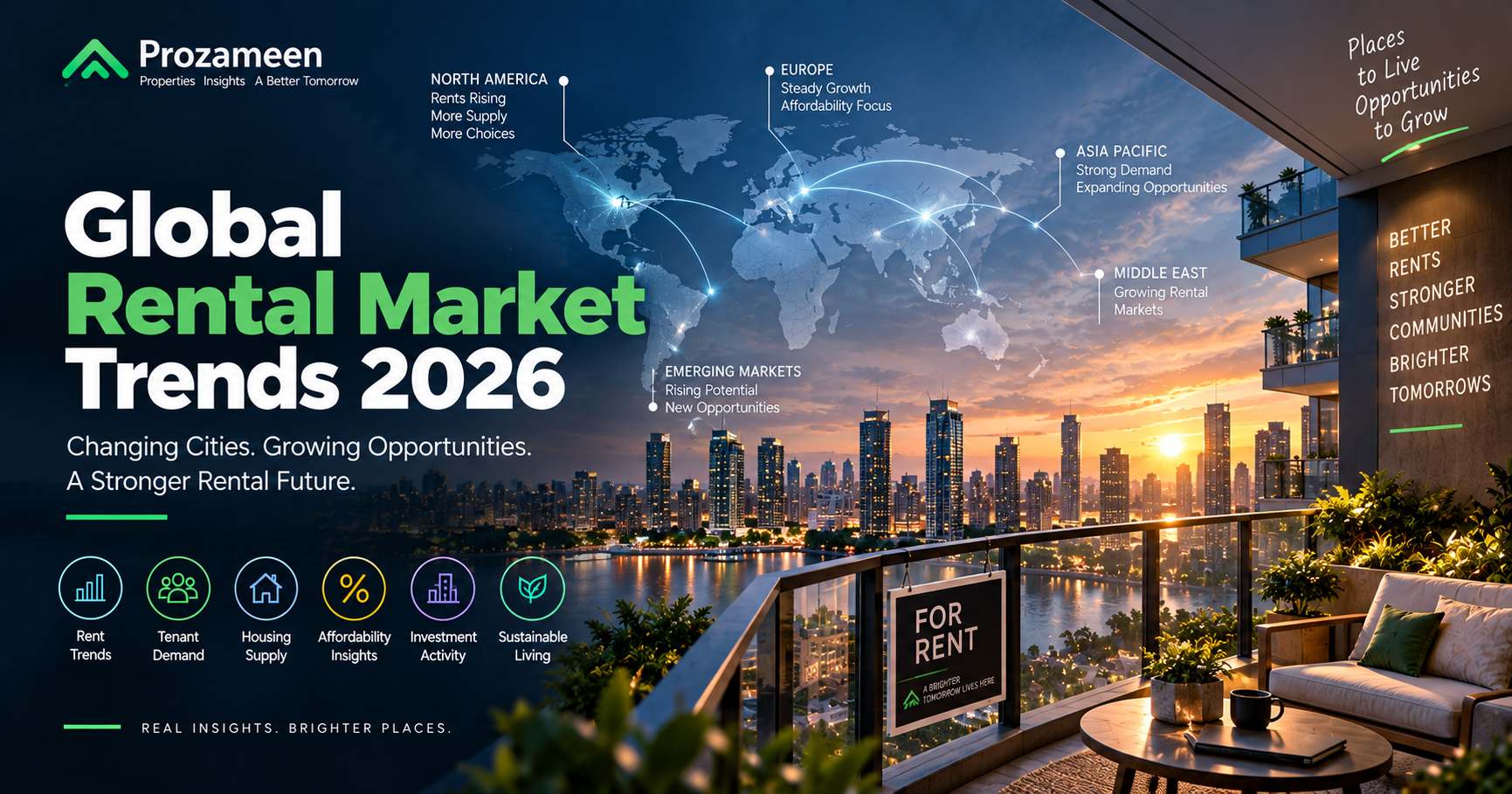
Global Rental Market Trends 2026
Global Rental Market Trends 2026
The global rental market in 2026 is being shaped by two powerful forces: strong demand for rental housing and uneven growth in new supply.
In some cities, years of apartment construction have given renters more choices and negotiating power. In others, limited housing supply continues to push rents higher.
The result is not one global rental trend, but a market increasingly divided by city, property type, affordability and housing supply.
The Prozameen Global Rental Market Trends 2026 report examines the major forces influencing renters, landlords and property investors across key international markets.
Executive Summary
Several themes stand out in the rental market during 2026:
Rental demand remains resilient in many major cities
Rent growth varies significantly between markets
New apartment supply has moderated rent growth in some locations
Markets with limited supply are experiencing stronger rental pressure
Rental affordability remains challenging for many households
Rent concessions remain common in some high-supply U.S. markets
European rental growth continues despite affordability pressure
Institutional investment in rental and living assets is increasing
Investors are increasingly focused on occupancy, operating costs and sustainable rental income
Local supply and demand matter more than headline global averages
The most important lesson from 2026 is that rental supply is becoming one of the strongest factors determining rent growth and tenant bargaining power.
There Is No Single Global Rent Trend
Unlike interest rates or some financial-market indicators, there is no single official global rental-price index covering every country and property type.
Rental markets operate locally.
A city experiencing rapid population growth and limited housing construction can behave very differently from a city where thousands of new apartments have recently entered the market.
This means global rental research should focus on regional and city-level evidence rather than assuming that one country's rental trend represents the world.
United States: Rent Growth Is Accelerating Again
The U.S. rental market provides a clear example of how additional housing supply can influence rents.
According to Zillow, the typical U.S. asking rent reached $1,962 in July 2026, representing annual growth of 2.3%, the fastest annual pace in more than a year.
However, renters still have negotiating power in many markets.
Zillow reported that 39.8% of U.S. rental listings offered a concession in July 2026, compared with 35.9% one year earlier. Concessions may include free rent, waived fees or other move-in incentives.
This creates an unusual market where rents are rising while incentives remain widespread.
New Supply Has Helped U.S. Renters
A large wave of apartment construction has helped limit rental growth in several U.S. cities.
Markets that added substantial new supply have generally offered renters more choices and more concessions.
For example, Zillow reported particularly high concession rates in Charlotte, Denver and Dallas during July 2026.
At the same time, cities where supply is tighter have experienced stronger rent growth.
This demonstrates an important rental-market principle:
More housing supply can increase competition between landlords and reduce pressure on renters.
The U.S. Supply Wave Is Beginning to Slow
The rental construction boom that supported renters over the past few years is beginning to moderate.
Zillow reported that multifamily permits in the second quarter of 2026 were 31% below their most recent peak in 2022.
CBRE also reported that U.S. multifamily construction completions fell 14% year over year in Q2 2026, while renter absorption remained strong.
If new supply continues to fall while demand remains strong, some rental markets could gradually become tighter.
U.S. Rental Affordability Remains Challenging
Moderate rent growth does not necessarily mean renting is affordable.
Zillow estimates that a median-income U.S. household would spend approximately 26.8% of its income on a new rental in July 2026.
The income required to afford the typical rental was approximately $78,488 per year.
The affordability burden differs significantly by city.
In July 2026, Zillow estimated that renters in New York would spend about 40.9% of median household income on a typical new rental, compared with considerably lower shares in markets such as Raleigh and Salt Lake City.
Europe: Rents Continue to Rise
European rental markets also remain under pressure.
Eurostat reported that EU rents increased 3.0% year over year in the first quarter of 2026.
Compared with the fourth quarter of 2025, EU rents increased by 0.7%.
At the same time, house prices increased faster than rents across much of the EU, with annual house-price growth of 5.1% in Q1 2026.
This relationship between purchase prices and rents is important because high home-buying costs can keep more households in the rental market.
European Cities Face a Supply Problem
JLL's 2026 European living research highlights declining housing supply as a major concern.
The company expects new living-sector supply in Europe to fall to its lowest level in more than two decades, while affordability pressure remains significant in many cities.
By Q2 2026, JLL reported that average residential rents across the European cities it tracks were growing by approximately 3.4%, slightly faster than the 3.1% growth in residential sales prices across those markets.
JLL also estimated that renting was more affordable than buying in roughly two-thirds of the key European cities in its analysis because of high property prices and mortgage costs.
Germany Shows How Affordability Can Slow Rent Growth
Germany provides an example of rental growth slowing when tenants reach affordability limits.
JLL reported that median asking rents in Germany's eight largest cities reached €17.98 per square metre in the first half of 2026, increasing approximately 3.0% annually.
That was less than half the 6.8% annual growth recorded during the comparable period one year earlier. JLL attributed much of the slowdown to increasing affordability pressure in major cities.
Interestingly, rental growth was stronger in some smaller cities and rural districts.
This shows how affordability pressures can cause rental growth to shift geographically rather than disappear entirely.
Asia Pacific Remains Highly Diverse
Asia Pacific cannot be described as one rental market.
Large differences exist between countries and cities based on:
Urbanisation
Population growth
New construction
International migration
Local regulation
Employment growth
Housing availability
Savills' 2026 occupier outlook reported broad expectations for continued residential rental demand across many international markets, with particularly strong expectations for rental growth in selected markets including India.
These were market expectations rather than completed full-year results, so they should be interpreted as outlook indicators rather than confirmed future performance.
Hong Kong Illustrates Demand From International Mobility
Hong Kong provides a useful example of how migration and relocation can affect rental demand.
JLL reported that expatriate relocations handled by relocation specialist Dwellworks Hong Kong increased 20% year over year during the first half of 2026.
JLL expects luxury residential rents in Hong Kong to increase by around 5% during 2026, supported by relocation demand.
This relates specifically to Hong Kong's luxury rental segment and should not be interpreted as representing the entire Asia-Pacific rental market.
Rental Housing Is Attracting More Investment
Institutional investors continue to increase their exposure to rental and living-sector real estate.
JLL reported that global living-sector investment increased approximately 9% in the first half of 2026 compared with H1 2025, with more than $114 billion in direct investment.
The living sector includes formats such as:
Multifamily rental housing
Build-to-rent
Student housing
Senior living
Other professionally managed residential formats
This investment activity suggests that large investors continue to see long-term demand for rental housing.
European Living Investment Is Also Growing
Investment momentum has been particularly visible in Europe.
JLL reported that EMEA living-sector investment reached €17.4 billion in Q2 2026, an increase of 49% year over year.
Total investment for the first half of 2026 reached €31.2 billion, around 10% higher than the same period in 2025.
Large multifamily transactions in countries including Sweden, the UK and Spain contributed significantly to this growth.
Why Investors Like Rental Housing
Rental housing can offer characteristics attractive to long-term investors, including:
Recurring rental income
Broad household demand
Potential inflation-linked rent growth
Large tenant markets
Portfolio diversification
Long-term urbanisation trends
But rental property also comes with risks.
These include:
Vacancy
Maintenance
Regulation
Tenant affordability
Financing costs
Property management
Local oversupply
Strong demand does not automatically make every rental property a strong investment.
Rent Growth and Rental Profit Are Different
A common mistake is assuming that rising rents automatically mean higher investment returns.
Rental profitability depends on both income and expenses.
Investors need to consider:
Rental income
Vacancy
Maintenance
Insurance
Property management
Service charges
Taxes where applicable
Mortgage payments
Interest costs
Renovation expenses
A property experiencing strong rental growth can still produce weak cash flow if operating and financing costs are high.
Rental Concessions Matter
Advertised rent does not always represent the effective rent paid by a tenant.
Landlords may offer:
One month free
Reduced deposits
Waived application fees
Free parking
Other incentives
This is particularly important in markets with significant new apartment supply.
Nearly two in five U.S. rental listings on Zillow offered a concession in July 2026, demonstrating why investors and renters should look beyond headline asking rents.
Single-Family and Apartment Rents Can Behave Differently
Rental-property type also matters.
Zillow reported in June 2026 that U.S. single-family rents were increasing approximately twice as quickly as multifamily apartment rents — 3.0% annually compared with 1.5%.
The difference reflected, in part, the much larger amount of new apartment supply entering the market.
Investors should therefore avoid treating all rental properties as one market.
Affordability May Limit Future Rent Growth
Landlords cannot assume rents can continue increasing indefinitely.
When rent grows faster than household income, tenants may respond by:
Moving to cheaper locations
Sharing accommodation
Choosing smaller homes
Remaining with existing landlords
Delaying household formation
Moving farther from city centres
Affordability can therefore act as a natural limit on rental growth.
This is already visible in some European cities where JLL has reported slower rental growth as tenant affordability becomes increasingly constrained.
Location Remains Critical
Rental demand can vary significantly within the same city.
Important location factors include:
Employment
Public transport
Universities
Schools
Shopping
Healthcare
Entertainment
Safety
New development
Competing rental supply
A property in a high-demand neighbourhood may perform very differently from a similar property only a few kilometres away.
What Should Renters Watch?
Renters should look beyond the headline monthly rent.
Important factors include:
Effective rent after concessions
Deposit
Utilities
Parking
Service charges
Lease length
Expected rent increases
Transport costs
Renewal conditions
In markets with abundant supply, renters may have greater negotiating power.
What Should Landlords Watch?
Landlords should focus on occupancy and sustainable income rather than rent increases alone.
Important indicators include:
Local vacancy
New construction
Tenant turnover
Rental concessions
Competing listings
Maintenance costs
Tenant affordability
Renewal rates
A smaller rent increase with stable occupancy can sometimes produce a stronger financial result than aggressively increasing rents and experiencing longer vacancies.
What Should Property Investors Watch?
Investors should evaluate rental property using several measures rather than rent growth alone.
Useful indicators include:
Rental yield
Net Operating Income
Cash flow
Cash-on-cash return
Cap rate
Vacancy
Tenant turnover
Operating expenses
Financing costs
The strongest rental investments are usually those where income, costs, location and tenant demand remain sustainable together.
Prozameen 2026 Rental Market View
The rental market in 2026 is best described as resilient but highly uneven.
Demand for rental housing remains strong in many markets because home ownership remains expensive and urban populations continue to require housing.
At the same time, recent construction has created more competition between landlords in some cities.
The most important trends to watch through the remainder of 2026 are:
Slowing new apartment construction
Rental affordability
Vacancy levels
Tenant concessions
Local wage growth
Migration
Mortgage affordability
Institutional investment
Regulation
Operating expenses
Markets where construction slows while tenant demand remains strong may experience greater rental pressure over time.
Markets with substantial available supply may continue to offer renters more choice and negotiating power.
Research Methodology
This report is a Prozameen synthesis of publicly available rental and living-sector research.
Primary sources include:
JLL
CBRE
Savills Research
Eurostat
Zillow Research
The report combines evidence from multiple regions because there is no single official global rent index covering all residential rental markets.
Market statistics should therefore be interpreted according to their stated country, city, property type and reporting period.
Research Period
January 2026 to September 2026
Latest major data incorporated: August 2026
Important Information
Rental markets vary significantly by country, city, neighbourhood and property type.
Prozameen provides this research report for general informational and educational purposes only.