
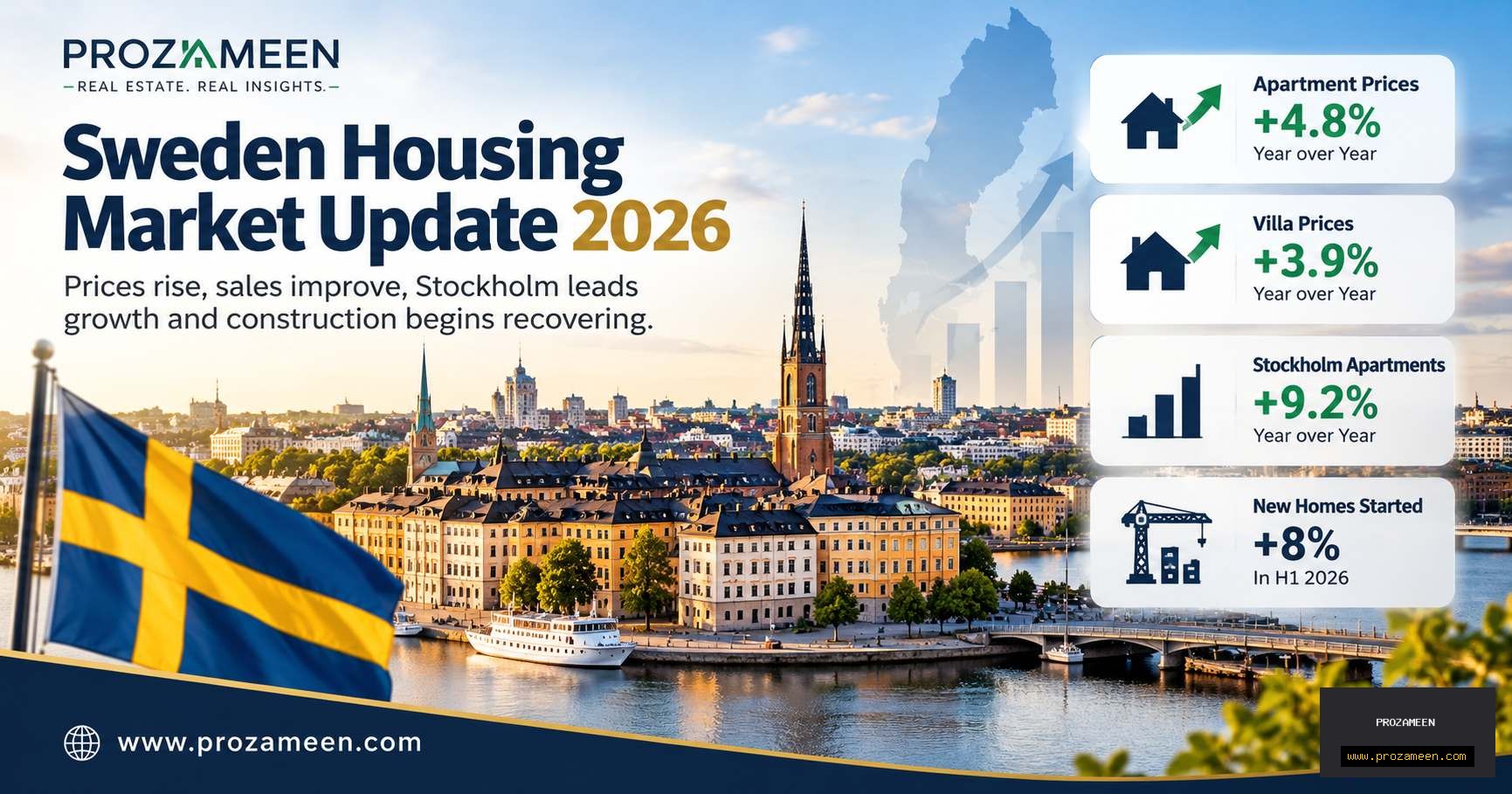
Sweden Housing Market Update 2026
Sweden’s housing market is showing clearer signs of recovery in 2026.
Home prices are higher than a year ago, transaction volumes have improved, Stockholm is outperforming several other major markets and residential construction has started to recover.
But the picture is not uniformly strong.
Apartment prices were almost flat nationally in August, villa construction remains weak and Swedish borrowers are now watching interest rates closely after the Riksbank signaled that future rate increases may come sooner than previously expected.
The result is a housing market that looks healthier than it did during the recent slowdown—but still requires careful local analysis.
Sweden Housing Market at a Glance
Latest August and September 2026 indicators show:
- National apartment prices up 4.8% year over year
- National villa prices up 3.9% year over year
- Central Stockholm apartment prices up 9.2% annually
- Greater Stockholm apartments up 6.7% annually
- Approximately 9,800 apartments sold in August
- Approximately 5,300 villas sold in August
- Apartment sales up 10% from August 2025
- Villa sales up 7% from August 2025
- Around 15,350 new homes started in H1 2026
- Riksbank policy rate at 1.75%
Together, these figures suggest that Sweden has moved beyond the weakest stage of its recent housing adjustment.
However, location remains extremely important.
Stockholm, Gothenburg and Malmö are not moving at the same speed.
Apartment Prices Are Rising Again
Swedish apartment prices were almost unchanged during August itself, slipping around 0.1% nationally.
But the longer-term trend is more positive.
Compared with the same period a year earlier, apartment prices were approximately 4.8% higher.
That difference is important.
A single month can be influenced by:
- Seasonal activity
- Types of homes sold
- Location mix
- Buyer behaviour
The annual trend provides a broader picture of market recovery.
For buyers and investors, this suggests that Sweden is no longer experiencing the same widespread downward pressure seen during the more difficult stage of the housing correction.
Stockholm Is Leading the Recovery
Stockholm remains the strongest major Swedish apartment market in the latest data.
Central Stockholm apartment prices were approximately 9.2% higher than a year earlier.
Greater Stockholm was up around 6.7%.
That is significantly stronger than several other parts of the country.
The difference reinforces an important real estate principle:
National housing statistics do not tell you what is happening in an individual city.
Stockholm is influenced by:
- Employment
- Population
- Limited central housing supply
- High household incomes
- Strong rental demand
- Urban lifestyle demand
Investors analysing Stockholm should therefore compare the city separately from Sweden as a whole.
Prozameen’s Rent vs Buy in Stockholm 2026 - Smart Housing Choice provides a deeper look at Stockholm housing decisions.
Stockholm Prices Can Vary Dramatically by Location
Even within Stockholm, the market is highly local.
Central Stockholm properties operate in a very different price environment from suburban municipalities.
Factors that can influence value include:
- Metro access
- Commuting time
- Schools
- Local services
- Property condition
- Association finances
- Neighbourhood reputation
That means buyers should avoid assuming that a strong Stockholm headline automatically applies to every property.
The correct analysis moves through several levels:
Sweden → Stockholm → Municipality → Neighbourhood → Building → Property
This approach is especially important for bostadsrätt purchases.
Greater Stockholm Apartments Remain Expensive
The average price per square metre for apartments in Greater Stockholm remains significantly above the national level.
This creates both opportunities and affordability challenges.
Higher prices can reflect:
- Stronger demand
- Greater employment density
- Better transport links
- Limited supply in attractive areas
But a higher property price also increases:
- Down-payment requirements
- Mortgage exposure
- Monthly interest costs
- Financial risk
Buyers should therefore evaluate Stockholm property based on monthly affordability rather than purchase price alone.
Prozameen’s How Much House Can I Realistically Afford? can help structure that calculation.
Gothenburg Is Recovering More Moderately
Gothenburg is also showing positive movement, although the pattern differs from Stockholm.
Central Gothenburg apartment prices were higher than a year earlier, while Greater Gothenburg showed more moderate annual growth.
This illustrates why city-level trends should always be separated from metropolitan averages.
Central districts may benefit from:
- Limited supply
- Urban demand
- Transport
- Universities
- Employment
Outer areas may respond differently to affordability and borrowing costs.
For property investors, comparing neighbourhood fundamentals remains more useful than simply choosing Sweden’s largest cities.
Malmö Shows a Softer Apartment Market
Malmö’s apartment market has been less aggressive than Stockholm.
Annual apartment price growth in Greater Malmö was much more limited in the latest figures.
This does not automatically mean Malmö is a weak market.
It may instead reflect different:
- Price levels
- Supply conditions
- Migration patterns
- Income levels
- Buyer behaviour
A slower price market can sometimes provide better affordability.
But investors should always test rental demand and local fundamentals separately.
Villa Prices Are Also Rising
Swedish villa prices increased around 0.6% during August and approximately 3.9% over the previous 12 months.
Greater Stockholm was particularly strong, with villa prices roughly 6% higher annually.
Family demand appears to remain important.
Housing decisions are frequently driven by life events such as:
- Growing families
- Separation
- Need for additional space
- Downsizing
- Relocation
This can support transaction activity even when interest rates remain relatively high.
Home Sales Are Increasing
Price movements are only one part of the housing market.
Transaction volume provides another important signal.
Around 9,800 apartments were sold during August 2026, approximately 10% more than during August 2025.
Around 5,300 villas were sold, approximately 7% higher year over year.
Villa transactions during August reached their highest level for that month since the current statistical series began.
Higher transaction volume can indicate:
- Greater buyer confidence
- More realistic seller pricing
- Improved financing conditions
- More willingness to move
A healthy housing market usually needs transactions, not only rising prices.
Homes Are Selling Faster
Another sign of changing conditions is listing time.
August market data show that apartments remained searchable for an average of approximately 58 days, slightly shorter than a year earlier.
For houses, the improvement was much larger.
Average listing duration fell to approximately 59 days, compared with around 73 days one year earlier.
Shorter marketing periods can indicate improving demand.
But investors should not interpret this as evidence that every property sells quickly.
Poorly priced or poorly located homes can remain on the market much longer.
Bidding Has Become More Competitive
The difference between asking prices and final sale prices also strengthened during August.
Average bidding premiums were around 1.9% for both apartments and houses in one major market dataset.
A year earlier, bidding conditions were weaker.
This suggests buyers are once again competing for desirable properties in some locations.
But bidding should never replace valuation discipline.
A buyer should understand:
- Comparable sales
- Property condition
- Association finances
- Future renovation needs
- Monthly housing cost
Winning a bidding process does not automatically mean getting a good deal.
Interest Rates Remain a Major Housing Factor
Swedish housing is highly sensitive to mortgage costs.
The Riksbank kept the policy rate at 1.75% in September 2026.
That rate is substantially lower than the levels reached during the previous tightening cycle.
Lower borrowing costs compared with earlier peaks have helped improve housing-market confidence.
However, the interest-rate story may be changing again.
The Riksbank has indicated that stronger economic activity and inflation pressures could require higher rates going forward.
If that happens, housing affordability could once again face pressure.
Why the Riksbank Matters to Home Buyers
The policy rate does not directly determine every mortgage rate.
But it influences financial-market conditions and bank funding costs.
When market rates rise, borrowers may face:
- Higher mortgage payments
- Lower borrowing capacity
- Reduced affordability
When rates fall, the opposite can happen.
This is why home buyers should avoid assuming that today's mortgage cost will remain unchanged throughout the ownership period.
Stress testing remains important.
For broader context, see Prozameen’s Mortgage Rates & Housing Demand Report 2026.
Sweden’s Mortgage Rules Changed in 2026
One major change affecting buyers occurred in April 2026.
For qualifying new home purchases, the regulatory mortgage cap was increased from 85% to 90% of the property’s market value.
This means the regulatory minimum equity contribution can be lower than previously required.
The additional amortization requirement linked to borrowing above 4.5 times gross annual income was also removed.
However, buyers should understand an important distinction:
A regulatory maximum is not a guaranteed bank loan.
Banks still make individual credit assessments based on factors such as:
- Income
- Existing debts
- Employment
- Household expenses
- Interest-rate stress tests
A buyer may therefore need significantly more than the minimum down payment.
Higher Loan-to-Value Can Increase Risk
A smaller down payment can make entering the housing market easier.
But it also means borrowing a larger proportion of the property value.
For example:
Property price: SEK 4,000,000
At 85% financing:
Loan = SEK 3,400,000
At 90% financing:
Loan = SEK 3,600,000
The buyer contributes less cash initially.
But the mortgage balance is SEK 200,000 higher.
That creates greater exposure to:
- Interest costs
- Property-price declines
- Household financial stress
Accessibility and affordability are not exactly the same thing.
Construction Is Starting to Recover
Sweden’s housing supply is also showing signs of improvement.
Approximately 15,350 dwellings were started during the first half of 2026.
That was around 8% more than during the same period in 2025.
The recovery was driven primarily by multi-dwelling housing.
This is important because several years of weaker construction created concerns about future housing supply, particularly in larger urban areas.
Apartment Construction Is Stronger Than House Building
The construction recovery is uneven.
Around 12,700 dwellings were started in multi-dwelling buildings during the first half of 2026.
That represented strong annual growth.
By contrast, construction starts for one- and two-dwelling homes declined.
Approximately 2,650 such dwellings were started, down roughly 18% year over year.
This indicates that Sweden’s supply recovery is currently concentrated more heavily in apartments than detached housing.
Why New Construction Matters for Prices
Housing supply influences both affordability and long-term property performance.
When construction remains too low relative to household formation and demand, existing homes can face additional price pressure.
When substantial new supply enters a local market, buyers and renters gain more alternatives.
Investors should therefore examine:
- Building permits
- Construction starts
- Population growth
- Local vacancy
- New projects
The national construction trend is useful.
Local development pipelines matter more.
Is Sweden Becoming a Seller’s Market Again?
Not necessarily everywhere.
Some indicators have strengthened:
- Higher annual prices
- More transactions
- Faster house sales
- Positive bidding premiums
But the market remains balanced by:
- High housing costs
- Mortgage uncertainty
- Regional differences
- Increased sensitivity to interest rates
A desirable Stockholm apartment may attract several bidders.
A property in a weaker local market may still require substantial negotiation.
There is no single Swedish market.
What Does the Market Mean for Buyers?
For buyers, 2026 presents a mixed environment.
Positive factors include:
- Improved market liquidity
- More confidence than during the downturn
- More accessible mortgage rules
Challenges include:
- Rising property prices
- High Stockholm valuations
- Potential future interest-rate increases
Buyers should therefore calculate the total monthly cost.
This includes:
- Mortgage interest
- Amortization
- Monthly association fee
- Electricity
- Insurance
- Maintenance
The listing price is only one part of affordability.
What Does It Mean for Sellers?
Sellers have generally benefited from improving market conditions.
Higher annual prices and stronger transaction volumes can create a better selling environment than during weaker periods.
However, realistic pricing remains important.
Buyers now have access to extensive market information and can compare competing properties easily.
An unrealistic asking price can still result in:
- Longer listing times
- Fewer bidders
- Price reductions
The strongest properties tend to attract attention first.
What Does It Mean for Investors?
Sweden can offer a stable and transparent housing market, but investors need to understand local rules and economics.
Important factors include:
- Purchase price
- Financing
- Monthly association fees
- Rental restrictions
- Tenant demand
- Local supply
- Property taxes and costs
- Resale liquidity
For bostadsrätt investors in particular, the financial position of the housing association can be extremely important.
High association debt can eventually influence monthly fees.
Before analysing any investment market, use Prozameen’s How to Evaluate a Property Market Before Investing.
Bostadsrätt Association Finances Matter
A Swedish apartment buyer is not only buying an individual home.
For a bostadsrätt, the buyer also becomes connected to the financial position of the bostadsrättsförening.
Important questions include:
- How much debt does the association have?
- What interest rates apply?
- Are major renovations planned?
- How much cash reserve exists?
- Have monthly fees recently increased?
Two similar apartments can have very different long-term costs because their associations have different finances.
This should be part of due diligence.
Stockholm Remains Sweden’s Key Market to Watch
Stockholm's strong annual price growth makes it the most important Swedish market to monitor through the rest of 2026.
But strong past performance does not guarantee future growth.
Buyers should monitor:
- Interest rates
- Apartment supply
- Employment
- New construction
- Household affordability
If prices continue rising faster than incomes, affordability could become a larger constraint.
What Could Slow the Recovery?
Several factors could weaken the Swedish housing market.
Higher Interest Rates
A renewed rate cycle could increase mortgage payments.
Weaker Employment
Housing demand depends heavily on household income and confidence.
Affordability
Rapid Stockholm price growth could limit the number of qualified buyers.
Increased Supply
More construction may reduce price pressure in some areas.
Consumer Confidence
Households may delay purchases if economic uncertainty increases.
The recovery therefore remains dependent on both economic and financial conditions.
What Could Support Further Growth?
Several forces could continue supporting Swedish housing.
Stronger Economic Activity
Improved household confidence could increase demand.
Population and Urban Demand
Major cities continue to attract residents.
Limited Supply in Prime Areas
Central Stockholm cannot easily create large amounts of new housing.
Improved Market Liquidity
More transactions can encourage households to move.
Housing markets often strengthen when buyers and sellers become more confident that transactions can be completed.
Sweden Compared With Global Housing Markets
Sweden’s housing recovery is part of a wider global pattern in which countries are moving in different directions.
Some markets are experiencing rapid price growth.
Others are becoming more favorable to buyers.
This makes cross-market comparison increasingly important.
Prozameen’s Global & Regional Real Estate Market Trends 2026 provides broader international context.
You can also explore the Global Property Price Trends Report 2026.
What to Watch Next in Sweden
During the final months of 2026, the most important indicators will be:
Apartment prices
Does national growth continue?
Stockholm
Can strong annual price growth be sustained?
Policy rate
Does the Riksbank begin raising rates?
Mortgage rates
How quickly do borrowing costs respond?
Transactions
Do strong sales volumes continue?
Construction
Does the recovery expand beyond apartments?
These indicators will help determine whether Sweden enters 2027 with a stronger housing market or a more cautious one.
Key Takeaways
Sweden’s housing market is strengthening in 2026.
The latest data show:
Apartment prices are higher than a year ago.
Villa prices are also rising.
Stockholm is outperforming nationally.
Housing transactions have increased.
Homes are generally selling faster.
Construction is beginning to recover.
But risks remain.
Potential interest-rate increases, affordability constraints and regional differences could influence the next stage of the market.
For buyers, 2026 offers a more active housing environment.
For sellers, conditions have improved.
For investors, Stockholm and other major cities deserve careful analysis—but the individual property, financing and local fundamentals still matter more than national headlines.
Important Information
Prozameen provides independent real estate information, research, calculators, tools and educational resources.
This article is based on publicly reported Swedish housing-market information available through September 2026 and is provided for general informational and educational purposes only.