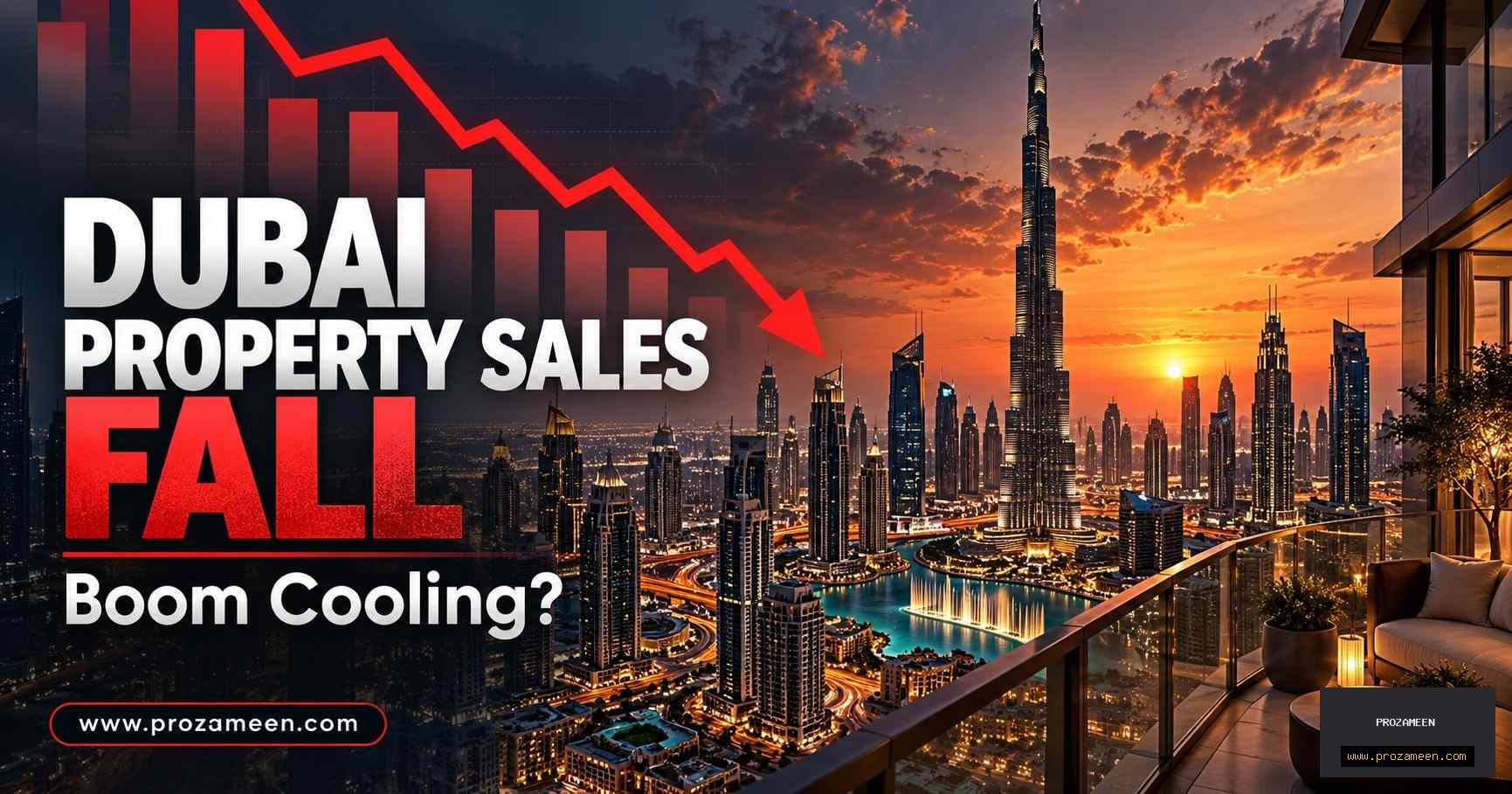
Dubai Property Sales Fall: Is the Boom Cooling?
For several years, Dubai’s property market seemed to move in only one direction.
Sales climbed, new projects launched at a remarkable pace, international buyers poured into the city, and prices rose across many apartment, villa and luxury-home markets.
Now, the picture is becoming more complicated.
Residential sales activity slowed during the second and third quarters of 2026. Buyers have more properties to choose from, developers are becoming more measured with new launches, and some parts of the premium market have started showing softer pricing.
So, is Dubai’s property boom finally running out of steam?
The evidence suggests the market is cooling, but that is very different from saying Dubai is heading for a property crash.
What appears to be happening is a transition from exceptional growth toward a more balanced and selective market.
And for property investors, that change matters.
Dubai Property Sales Are Slowing
Dubai entered 2026 with significant momentum, but the pace of transactions began to moderate as the year progressed.
Residential transactions fell by around 19% quarter-on-quarter in Q2 2026, reaching approximately 35,884 transactions.
The market cooled further in the third quarter, when roughly 34,500 residential transactions were recorded, about 4% lower than Q2.
Those numbers do not suggest that buyers have suddenly abandoned Dubai.
Instead, they show that the market is moving away from the extraordinary transaction levels seen during the strongest stage of the recent property cycle.
Buyers now have more choice.
They have more projects to compare, more completed homes available and more reasons to question whether a particular asking price represents good value.
That change in buyer behaviour may become one of the defining features of the Dubai property market heading into 2027.
Is the Dubai Property Boom Cooling?
Yes, Dubai’s property market is showing signs of cooling and normalization.
But cooling should not automatically be interpreted as a crisis.
A property market can cool when:
-
transaction growth slows;
-
buyers take longer to make decisions;
-
sellers face greater negotiation;
-
developers compete harder for buyers;
-
price growth becomes less consistent;
-
some communities outperform others;
-
investors focus more closely on rental income and real returns.
Several of these conditions are now becoming visible in Dubai.
In some ways, this could be healthy.
No property market can maintain exceptional growth forever. A more balanced environment encourages investors to focus on fundamentals instead of assuming that almost every property will rise rapidly in value.
Anyone evaluating Dubai as an investment market can also read Prozameen’s Dubai Real Estate Investment Guide 2026 for a deeper look at ownership, costs, rental returns and investment considerations.
Why Are Dubai Property Sales Slowing?
There is no single explanation.
Several changes are taking place at the same time.
Buyers Have More Choice
One of the biggest differences between today’s market and the earlier boom period is choice.
Dubai continues to add new residential developments, while thousands of previously launched homes are reaching completion.
For buyers, this creates more options.
Instead of feeling pressure to purchase quickly before prices rise again, buyers can compare communities, developers, layouts, payment plans and completed properties.
The question is gradually changing from:
“Can I buy before prices rise further?”
to:
“Is this property actually worth the asking price?”
That is the behaviour of a more selective property market.
Off-Plan Buyers Are Becoming More Careful
Off-plan property has been one of the main drivers of Dubai’s real-estate expansion.
During the strongest period of the market, many newly launched developments attracted buyers rapidly because investors expected prices to continue appreciating.
That environment is beginning to change.
Today, experienced buyers are increasingly looking beyond attractive brochures and payment plans.
They are asking:
-
Who is the developer?
-
What has the developer completed before?
-
How much competing supply is coming nearby?
-
Is the launch price realistic?
-
What rent could the property achieve after completion?
-
Will there be genuine end-user demand?
-
How easy could resale be?
This does not mean Dubai’s off-plan market is disappearing.
It means strong projects may increasingly separate themselves from weaker ones.
Before committing money to any project, buyers should conduct proper checks. Prozameen’s Property Due Diligence Guide explains the key areas investors should investigate before purchasing property.
More Homes Are Reaching the Dubai Market
Supply is becoming one of the most important issues for Dubai property investors.
Approximately 27,300 residential units were handed over during Q2 2026, representing one of the strongest recent quarters for new-home completions.
More housing is not automatically negative.
Dubai’s population continues to grow, and a larger population requires more homes.
The investment risk appears when a particular community receives more similar properties than local demand can comfortably absorb.
This is why investors should avoid viewing Dubai as one single property market.
Dubai Marina, Downtown Dubai, Business Bay, Jumeirah Village Circle and individual villa communities can experience completely different supply-and-demand conditions.
A strong Dubai-wide market does not guarantee that every community or project will perform equally well.
Are Dubai Property Prices Falling?
The answer depends on where you look.
Falling transaction volumes do not automatically mean that property values across Dubai are collapsing.
During Q3 2026, headline apartment and villa prices showed signs of moderation, while comparable properties in many parts of the market remained relatively stable.
This suggests that part of the movement in average prices can also be explained by the type and value of properties being sold.
However, certain prime areas have experienced clearer price pressure.
That makes location-level analysis increasingly important.
Instead of simply asking:
“Are Dubai property prices rising or falling?”
investors should ask:
-
Which community?
-
Which building?
-
Which property type?
-
What is the current asking price?
-
What have comparable properties actually sold for?
-
How much new supply is coming?
-
What rent can the property realistically generate?
Those questions provide far more useful information than one Dubai-wide percentage.
Dubai’s Luxury Market Is Becoming More Selective
Dubai remains one of the world’s most active luxury property markets.
But even the premium segment has started showing signs of moderation.
During Q3 2026, 86 residential properties priced above US$10 million were sold in Dubai.
That was lower than the 131 transactions recorded during the previous quarter.
However, the broader picture remains impressive.
Dubai recorded 412 transactions above US$10 million during the first nine months of 2026.
So luxury demand has certainly not disappeared.
The better interpretation is that buyers at the top of the market are becoming more selective after several years of extraordinary price growth.
Some prime locations have also experienced price adjustments.
Again, that points more toward market normalization than the disappearance of luxury demand.
Is Dubai Heading for a Property Crash?
At this stage, calling the current situation a Dubai property crash would be misleading.
A serious housing-market crash normally involves several conditions happening together:
-
widespread and rapid price declines;
-
distressed or forced selling;
-
sharply weakening demand;
-
falling rents;
-
financing stress;
-
excessive leverage;
-
major deterioration in buyer confidence.
Dubai is experiencing slower transaction activity and greater buyer selectivity, but those broader crash conditions are not currently evident across the entire market.
Ready-property transactions remain active.
Rental activity has remained resilient.
Luxury properties are still attracting substantial capital.
And developers are adjusting the pace of project launches rather than simply releasing unlimited new supply into the market.
For readers concerned about broader downside scenarios, Prozameen’s Housing Market Crash 2027: Global Risk Outlook examines the risks facing major housing markets worldwide.
Could Supply Become Dubai’s Biggest Risk?
This may be the most important question for investors heading into 2027.
Current development pipelines indicate that more than 525,000 residential units are scheduled for delivery between 2027 and 2030.
That is a substantial number.
However, investors should not assume that every announced property will arrive exactly on schedule.
Large real-estate markets regularly experience construction delays, phased deliveries and revised development timelines.
The real question is how much housing will actually be completed—and whether Dubai’s population and housing demand will grow quickly enough to absorb it.
If demand keeps pace with new supply, Dubai could gradually move toward a healthier balance.
But if supply significantly outpaces demand in certain communities, rents and resale prices in those locations could face pressure.
This is why 2027 could become a particularly important year for the Dubai property market.
For the wider global picture, see Prozameen’s Global Housing Market Outlook 2027.
Rental Demand Could Support the Market
One reason investors should be cautious about predicting a major Dubai property downturn is the rental market.
Residential rental activity increased by approximately 16% quarter-on-quarter during Q3 2026.
Strong rental demand can provide important support to investment properties, especially when capital appreciation becomes less predictable.
This could also change how investors evaluate opportunities.
During a rapidly rising property market, investors sometimes focus almost entirely on how much the property might be worth in two or three years.
In a more balanced market, rental fundamentals become much more important.
Investors need to know:
-
What rent can realistically be achieved?
-
What are the annual service charges?
-
How much should be allowed for maintenance?
-
What vacancy period is realistic?
-
What is the property’s net operating income?
-
What is the gross rental yield?
-
What return remains after costs?
Prozameen’s Rental Yield Calculator can help investors estimate the relationship between rental income and property value.
What Should Dubai Property Investors Do Now?
A cooling market does not automatically mean investors should stop buying property in Dubai.
It means investors need to become more disciplined.
Before buying, compare similar properties rather than relying solely on developer marketing or market-wide price-growth claims.
Consider:
-
purchase price;
-
recent comparable transactions;
-
rental income;
-
service charges;
-
maintenance;
-
vacancy;
-
financing costs;
-
purchase fees;
-
resale costs;
-
existing supply;
-
future supply;
-
developer quality;
-
long-term demand.
Investors should also be clear about why they are purchasing.
A property bought for long-term rental income requires a different strategy from one purchased for personal use or short-term resale.
Prozameen’s Property Deal Analyzer can help investors compare a property's financial assumptions before making a decision.
Which Dubai Properties Could Be More Resilient?
No property or neighbourhood is guaranteed to rise in value.
But when markets become more selective, strong fundamentals generally matter more.
Properties may be better positioned when they offer a combination of:
-
established infrastructure;
-
good transport connections;
-
genuine end-user demand;
-
realistic pricing;
-
healthy rental demand;
-
manageable service charges;
-
reputable development quality;
-
limited competing supply;
-
practical layouts.
Investors should be especially careful with properties whose entire investment case depends on aggressive future price appreciation.
If a property only appears attractive when assuming prices will rise 15% or 20% every year, its risk profile is very different from a property that can generate sustainable rental income at today’s purchase price.
What Should Buyers Watch in 2027?
Five indicators deserve particular attention.
Transaction Volumes
If sales stabilize or begin increasing again, it could indicate that buyers are adjusting successfully to greater choice and changing market conditions.
Property Prices
Investors should monitor prices at the community and property-type level rather than relying only on Dubai-wide averages.
Residential Handovers
Actual completed properties matter more than future announcements.
The pace at which new homes are delivered will be one of the most important indicators in 2027.
Rental Growth
If rents remain strong, they could continue supporting investment values even if sales activity grows more slowly.
Developer Launches
A more disciplined approach to new launches could help maintain a better balance between future housing supply and demand.
Dubai’s Property Market Is Changing, Not Disappearing
Dubai real estate appears to be entering a different stage of its property cycle.
After several years of exceptional growth, slower transaction activity should not automatically be viewed as a crisis.
Buyers have more choice.
Developers are becoming more measured.
Some prices are adjusting.
Future supply is becoming increasingly important.
And investors are being forced to look more carefully at actual property fundamentals.
There is still a major difference between a market cooling after years of exceptional growth and a market collapsing.
Current evidence supports the first description much more strongly.
For serious investors, that may ultimately be positive.
When rapid appreciation becomes less predictable, good property decisions depend less on market hype and more on location, price, rental income, supply, costs and long-term demand.
That is exactly when careful property research becomes most valuable.
Data Note: Market figures referenced in this article reflect Dubai residential-market information available through October 2026. Real-estate conditions can change, and individual communities may perform differently from the wider market.
Disclaimer: This article is provided for general information and market research purposes only. It does not constitute financial, investment, legal or property-buying advice. Buyers should conduct independent due diligence before making property decisions.