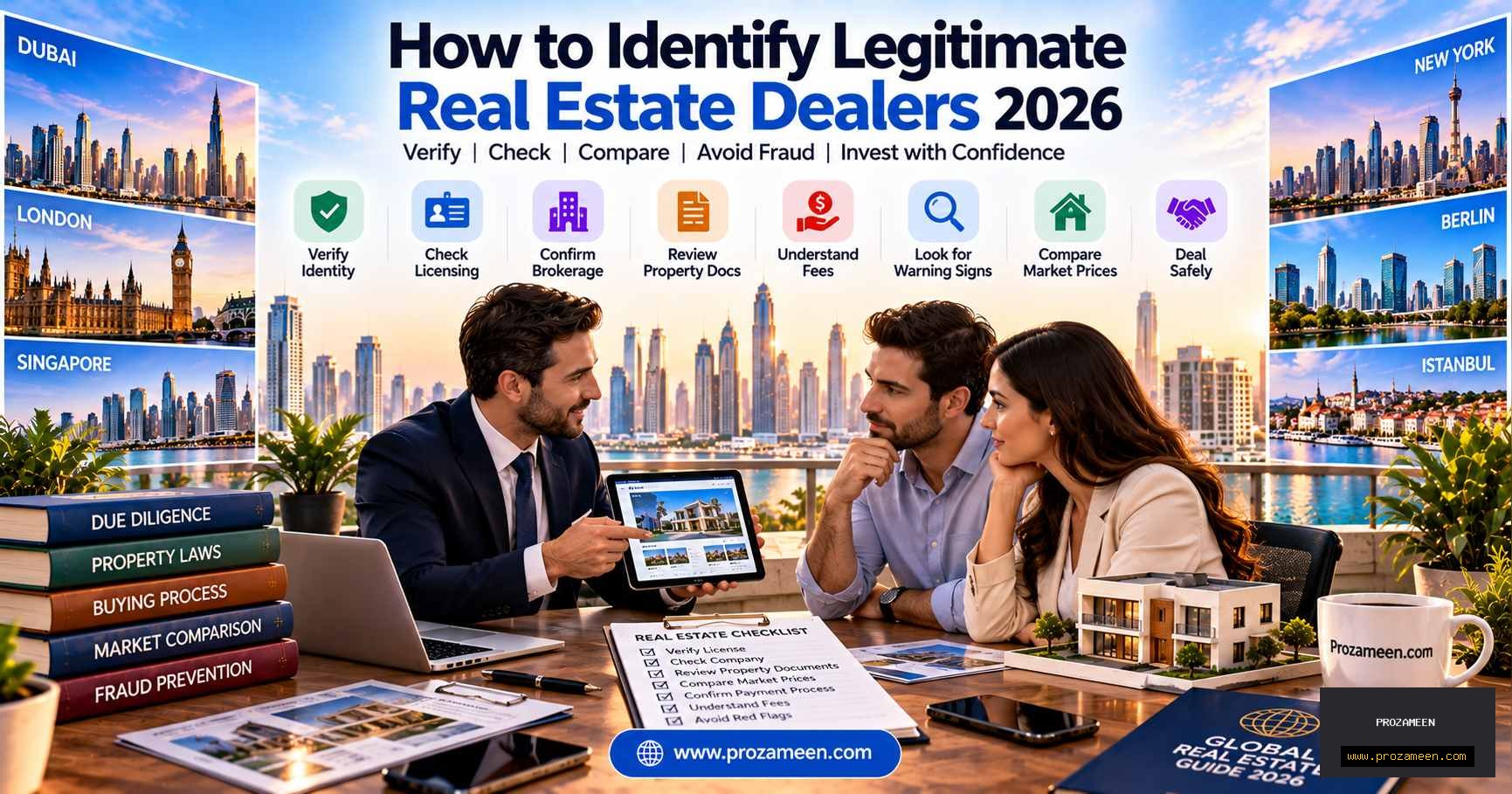
How to Identify Legitimate Real Estate Dealers 2026
Finding a property is only part of the buying process.
The person or company presenting that property matters just as much.
A professional real estate dealer, broker or agent can help buyers understand local markets, arrange viewings, communicate with sellers and coordinate parts of a transaction. But property markets also attract unlicensed intermediaries, misleading advertisements and sometimes outright fraud.
For buyers, especially those purchasing property in another city or country, the challenge is knowing who can actually be trusted.
The safest approach is not to rely on appearance, social-media popularity or confident sales language. Instead, verify the dealer's identity, professional status, authority, fees and the property itself before transferring money or signing an agreement.
The terminology differs by country. One market may use real estate agent, another broker, property dealer, estate agent or property consultant. The title matters less than whether the person is legally authorized to perform the services they are offering.
What Is a Legitimate Real Estate Dealer?
A legitimate real estate professional should be able to clearly explain:
- Who they are
- Which company they represent
- What services they provide
- Who they represent in the transaction
- What fees or commission they charge
- Whether local law requires licensing or registration
- What authority they have to market the property
A trustworthy professional should also be comfortable with reasonable verification.
If someone becomes defensive because you ask for their professional details, that is worth paying attention to.
Property transactions involve large amounts of money. Verification should be normal, not offensive.
Start by Verifying the Person's Identity
Before discussing deposits or payments, establish exactly who you are dealing with.
Ask for their full professional name and company details.
Confirm that the information matches their business cards, email, website, invoices and contracts.
Be cautious when someone communicates only through a messaging app and cannot provide reliable business information.
A legitimate business relationship should leave a clear trail of who is involved.
Check Whether Licensing Is Required
Real estate licensing rules differ widely.
Some countries require individual agents to hold a license. Others regulate the brokerage company. Some jurisdictions use professional registration systems.
Before working with someone, determine what the local rules require.
If licensing is mandatory, verify that the dealer's license:
- Exists
- Is current
- Matches their name
- Matches their brokerage
- Covers the type of activity being performed
Do not rely only on a photograph of a license sent through a messaging application.
Where possible, verify professional status through the relevant regulator, land authority or licensing body.
Verify the Brokerage Company
An individual may appear professional while claiming to work for a legitimate company without authorization.
Check whether the brokerage itself is properly established.
Look for consistent information across:
- Company name
- Business address
- Telephone number
- Website
- Email domain
- Registration information
- Agent details
If the person claims to represent a well-known brokerage, contact the company independently using contact details you obtained yourself.
Do not use only the phone number supplied by the person you are verifying.
Professional Email and Communication Matter
A legitimate professional can use messaging applications, but important transaction information should not depend entirely on informal chat.
Be cautious if the dealer:
- Refuses to use email
- Constantly changes numbers
- Uses several different names
- Cannot provide company documentation
- Avoids written confirmation
- Pressures you to communicate privately
Good communication does not prove legitimacy, but inconsistent communication can reveal problems early.
Be Careful With Social Media
Social media has become an important property-marketing channel.
Agents may advertise homes through Instagram, Facebook, TikTok, YouTube or messaging groups.
But a large following does not prove professional authorization.
Accounts can display:
- Expensive properties
- Luxury cars
- Office backgrounds
- Customer testimonials
- Professional videos
None of these automatically confirms that the person is licensed or that the advertised property is genuinely available.
Treat social media as a place to discover property, not as proof that a transaction is legitimate.
Verify the Property Separately
Even if the dealer appears legitimate, verify the property itself.
Do not assume that someone has the right to market or sell a property simply because they have photographs, keys or documents.
Depending on the market, verify:
- Legal owner
- Property title
- Registration details
- Outstanding mortgage
- Existing liens or claims
- Building approvals
- Existing tenancy
- Service charges
- Seller's authority
For a structured review, use Prozameen's Property Due Diligence Guide.
Confirm the Dealer Has Authority to Market the Property
A legitimate dealer should be able to explain why they are advertising the property.
They may have been appointed by:
- The owner
- Developer
- Landlord
- Brokerage
Ask whether there is a written marketing agreement or other authorization where this is customary or required.
This becomes particularly important when several agents are advertising the same property.
Duplicate advertisements can create confusion over who actually represents the seller.
Compare the Listing With Market Evidence
Fraudulent or misleading property advertisements often rely on one powerful technique:
an unusually attractive price.
If comparable properties cost 500,000 and one listing is advertised for 330,000, investigate why.
There may be a legitimate explanation.
But an unrealistic bargain can also be designed to make buyers act quickly.
Use the Property Comparison Tool to compare several properties rather than judging one listing in isolation.
You can also read How Do I Know If a Property Is Overpriced? when evaluating whether an asking price is supported by the market.
Visit the Property Whenever Possible
A genuine dealer should normally be able to arrange a legitimate viewing where circumstances allow.
During a viewing, confirm that the property actually matches the advertisement.
Check:
- Layout
- Floor
- Unit number
- Building
- Condition
- Parking
- View
- Fixtures
- Amenities
Prozameen's Property Viewing Checklist can help you organize what to examine.
If you are buying remotely, independent local verification becomes even more important.
Ask Detailed Questions
A knowledgeable real estate professional should understand the property they are marketing.
Ask questions such as:
How long has the property been available?
Why is it being sold?
What are the annual ownership costs?
Are there outstanding service charges?
Is the property occupied?
What is included in the sale?
Has the property been renovated?
Are there any restrictions?
A dealer may not know every answer immediately.
The warning sign is when they repeatedly avoid questions or provide contradictory information.
Understand Who the Dealer Represents
A property professional may represent:
- The seller
- Buyer
- Landlord
- Tenant
- Developer
Do not automatically assume they are acting exclusively in your interest.
Ask directly:
Who do you represent in this transaction?
This helps you understand the professional relationship and possible conflicts of interest.
Even when someone is helpful, buyers should conduct their own research.
Ask About Commission Before Proceeding
Commission should not appear as a surprise at the end of the transaction.
Ask:
- How much is the commission?
- Who pays it?
- When is it payable?
- Are there additional fees?
- Is tax included?
- What services are included?
Get important fee information in writing.
When calculating the true cost of a purchase, include brokerage and transaction expenses using Prozameen's Property Purchase Cost Planner.
Be Suspicious of Pressure to Pay Quickly
One of the biggest property fraud warning signs is artificial urgency.
Common pressure tactics may include:
“Someone else is transferring the deposit now.”
“This price is available only today.”
“Send a booking payment immediately.”
“You will lose the property in one hour.”
Real property markets can be competitive, and genuine opportunities can move quickly.
But urgency should never prevent verification.
The larger the transaction, the more important it is to confirm the facts before paying.
Never Send Money to an Unverified Personal Account
Be extremely careful when a dealer asks you to transfer:
- Booking money
- Deposit
- Reservation fee
- Commission
- Purchase funds
to a personal account without proper documentation.
Before transferring money, confirm:
- Recipient name
- Purpose of payment
- Contract
- Property
- Company
- Refund conditions
- Official payment procedure
If bank details suddenly change, independently confirm the new instructions before sending anything.
Property transactions are valuable targets for payment fraud.
Avoid Cash Transactions Without Documentation
Cash payments can make it difficult to prove what happened later.
If a payment is required, obtain appropriate documentation showing:
- Amount
- Date
- Purpose
- Property
- Recipient
- Transaction reference
The payment method should comply with local law and normal transaction procedures.
Read Everything Before Signing
Do not sign documents because someone says:
“This is only a formality.”
Read the document.
Understand:
- What you are agreeing to
- What the payment represents
- Whether it is refundable
- What happens if financing fails
- What happens if the seller withdraws
- What happens if you withdraw
- When commission becomes payable
Where necessary, obtain independent legal advice.
For a broader understanding of the buying process, read Prozameen's How to Buy a Property: Step-by-Step Guide.
Be Careful With Guaranteed Investment Claims
A real estate dealer may provide market information, but investors should be cautious when sales presentations promise:
- Guaranteed appreciation
- Guaranteed resale price
- Risk-free investment
- Guaranteed high rental return
Any guarantee should be examined carefully.
Ask:
Who provides the guarantee?
For how long?
Under what conditions?
Is it written into a legally enforceable agreement?
What happens if the promised return is not achieved?
A projection is not the same thing as a guarantee.
Check Rental Claims Yourself
If a dealer says a property will generate a particular rent, verify that claim using comparable rental evidence.
Look at similar units in the same building or nearby area.
Then consider:
- Vacancy
- Maintenance
- Management
- Service charges
- Insurance
Use Prozameen's Rental Yield Calculator instead of relying only on advertised yield.
Be Cautious With Off-Plan Property
Off-plan transactions deserve additional verification because the completed property may not yet exist.
Check:
- Developer
- Project registration
- Required approvals
- Payment structure
- Construction status
- Handover terms
- Cancellation conditions
- Resale restrictions
Do not treat impressive computer-generated images as proof of what will ultimately be delivered.
The legal documentation matters more than the brochure.
International Buyers Need Extra Care
Buying property abroad can make verification more difficult.
You may not know:
- Local terminology
- Licensing requirements
- Property law
- Taxation
- Registration process
- Market prices
That makes independent research especially important.
Before entering another market, Prozameen's Best Countries to Invest in Real Estate 2026 can help you understand the wider factors involved in international property investment.
How to Verify Online Property Advertisements
When you find a property online, compare the advertisement across different sources.
Look for inconsistencies in:
- Price
- Location
- Owner
- Agent
- Photographs
- Property size
- Contact details
You can also examine whether the same images are being used for completely different properties.
An advertisement should be treated as the beginning of your research—not the end.
Signs of a More Professional Dealer
No single characteristic proves legitimacy, but professional real estate dealers tend to behave consistently.
They usually:
- Identify themselves clearly
- Explain their role
- Provide written information
- Disclose fees
- Answer reasonable questions
- Allow verification
- Avoid unrealistic guarantees
- Follow established transaction procedures
- Provide proper documentation
Good professionals understand that serious buyers will conduct due diligence.
Warning Signs You Should Not Ignore
Be cautious when someone:
- Refuses to provide professional details
- Cannot explain their brokerage relationship
- Uses only informal communication
- Pressures you to send money immediately
- Requests payment to unrelated accounts
- Advertises unrealistic prices
- Promises guaranteed profits
- Refuses property viewings
- Avoids ownership questions
- Provides inconsistent documentation
- Discourages legal review
- Claims verification is unnecessary
One warning sign does not always prove fraud.
Several warning signs appearing together should make you stop and investigate further.
Do You Always Need a Real Estate Dealer?
Not necessarily.
In some markets, buyers can search for and purchase property directly.
However, buying independently means taking responsibility for more of the process.
Whether you use a dealer or not, you still need to verify:
- Ownership
- Property value
- Condition
- Legal documents
- Financing
- Costs
The quality of the transaction depends more on due diligence than on whether an intermediary is involved.
Dealer Reputation Is Useful, but Not Enough
Recommendations and reviews can help, but they should not replace formal verification.
Online reviews can be:
- Genuine
- Outdated
- Incomplete
- Manipulated
Use reputation as one piece of evidence.
A better process combines:
Professional verification + property verification + documentation + independent research.
Compare the Property Yourself
Even when working with a trusted dealer, do not depend entirely on their recommendation.
Compare several properties based on:
- Price
- Location
- Rental potential
- Ownership costs
- Property condition
- Resale demand
The Property Comparison Tool can help structure this analysis.
A Practical Dealer Verification Checklist
Before proceeding with a real estate dealer, ask yourself:
Identity
Do I know exactly who this person is?
Company
Can I verify the brokerage they represent?
License
Have I checked any required professional registration?
Authority
Are they authorized to market the property?
Property
Have I independently verified the property?
Fees
Do I understand commission and other charges?
Contract
Have I read everything before signing?
Payment
Do I know exactly who receives my money and why?
Claims
Have I independently checked rent, price and return projections?
Due diligence
Have I verified ownership and legal documentation?
If several answers are “no,” do not allow pressure to push the transaction forward.
Key Takeaways
A legitimate real estate dealer should be transparent, verifiable and comfortable with reasonable due diligence.
Do not judge credibility by clothing, office appearance, social-media followers or confident sales language.
Instead:
Verify identity.
Check licensing where required.
Confirm the brokerage.
Verify authority to market the property.
Check the property independently.
Understand fees.
Read contracts.
Verify payment instructions.
Question unrealistic promises.
Never let urgency replace due diligence.
A professional intermediary can make a property transaction easier.
But responsibility for protecting your money should never be handed entirely to someone else.
Trust should come after verification—not instead of it.
Important Information
Prozameen provides independent real estate information, research, calculators, tools and educational resources.
Prozameen does not certify, verify, recommend or guarantee individual real estate dealers, brokers, agents, developers or property listings unless explicitly stated otherwise.
This article is provided for general informational and educational purposes only.
Licensing rules, property transaction procedures and consumer protections vary by jurisdiction. Buyers should verify current requirements with the appropriate authorities and obtain professional assistance where necessary.